



Power generation for July 2025 has declined by about 5 percent YoY, and nearly 10 percent below the pricing benchmark, reaffirming how ill-planned policies and wishful projections are driving the country’s energy and industrial sectors towards even deeper structural challenges.
In July 2025, the power tariff was reduced by Rs 1.15/kWh for all consumers. However, the price consumers pay for electricity went up by Rs 2.45/kWh as the reduction was offset by expiry of the Rs 1.70/kWh tariff differential subsidy (TDS) given from April to June 2025 and the Rs -1.9/kWh QTA for FY25Q2.
The Rs 1.70/kWh TDS itself was initially planned to be financed from the levy on captive gas consumption, effective from February 2025.
The government conveyed in its Memorandum of Economic and Financial Policies to the IMF that “at least Rs. 0.90/kWh reduction could be front-loaded from the levy funds. And further relief would be brought as captive load transitioned to grid and lowered capacity costs for all.”
It is inconceivable that billions in revenue were expected from the levy when the objective was to transition captive load to the grid. As a result, captive gas consumption declined by around ~90 percent YoY under SNGPL and ~50 percent under SSGC, and the incorrect calculation of the levy was also injuncted by courts.
Consequently, little to no revenue has materialised. Instead, the government withheld savings from a dip in international oil prices (linked to the Trump Tariffs) through the Petroleum Development Levy and used these funds to provide the Rs 1.70/kWh relief.
As far as the lowered capacity costs for all go, this did not materialize either despite the transition of 600-800MW of captive load to the grid. As per Nepra’s decision on the QTA for FY25Q4, industrial sales increased by 46 percent compared to the same quarter in FY24, driven by the shift of 280 captive users to the grid and lower grid prices from April to June 2025.
However, overall purchases of DISCOs were only 0.35 percent above the reference period as around an equivalent load exited the grid for — most likely — solar. Rather, the Rs -1.89/kWh QTA for FY25Q4 was driven by the termination of IPP contracts (Rs 17 billion), renegotiation with IPPs (Rs 4 billion), debt reprofiling of K-2 and K-3 nuclear plants (34 billion), and non-availability of Neelum-Jhelum Hydro (Rs 19 billion).
Moving forward, the above impacts (of IPP terminations, renegotiations, and transition of captive users), representing the culmination of the power sector’s reform efforts over the past year, were integrated into projections for FY26, resulting in a Rs 1.15/kWh reduction in base tariffs and marking the end of the era of sizable negative quarterly adjustments.
Now the alarm bells are ringing again as grid demand was stagnant in FY25Q4 and closed 10 percent below the reference level in July 2025, indicating the grid’s failure to adapt to a phenomenon that has the entire world on its feet: Pakistan’s solar revolution.
While the power division’s major focus has been on getting rid of net-metering, the issue is simply that the grid is unable to compete with captive solar. In fact, replacing net-metering with gross metering, as has been suggested, may even exacerbate the challenges faced by the grid.
Critics of net-metering advance two main arguments: netmetered users pay less than their fair share towards the system’s capacity costs, thus increasing the burden on other consumers, and their increasing exports are a source of instability for the grid.
The capacity costs issue is valid but can’t be addressed without acknowledging the other side of the equation:~70 percent of residential consumption on the grid — ~35 percent of total consumption — is priced significantly below cost and cross subsidised by time-of-use consumers eligible for net-metering.
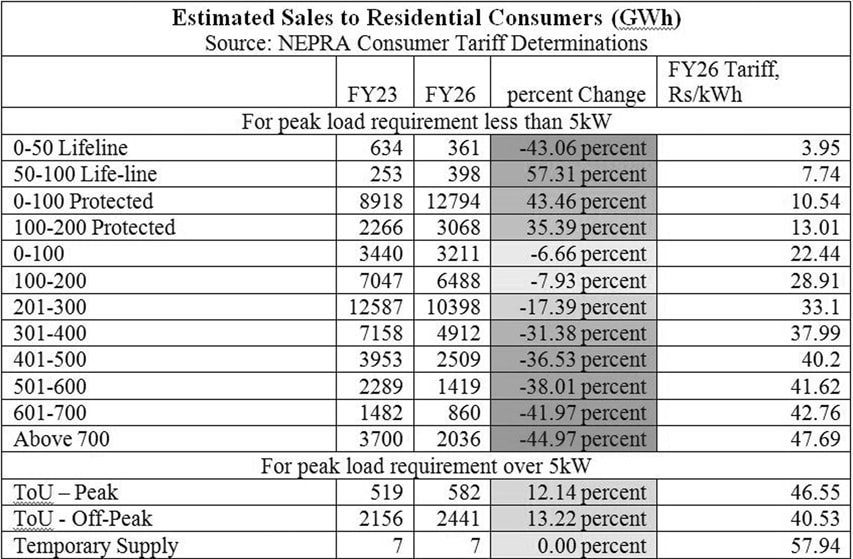
Comparison of estimated sales for FY23 and FY26 show consumption of unprotected non-ToU consumers—those opting for off-grid solar solutions—has fallen across all slabs, and that of protected and lifeline consumers has increased by 30 percent to 60 percent, from 21 percent of total residential consumption in FY23 to 32 percent in FY26.
These trends stem from non-ToU consumers adopting off-grid solar, slashing their grid consumption, and qualifying for protected slabs. Whether such consumers should even be eligible for the protected tariff is debatable, but it clearly establishes that net-metering is not the problem it is being made out to be, rather these consumers are only socially and politically easier for the government to scapegoat.
Even if we concede that netmetered should be eliminated, gross metering at distorted grid tariffs with a onethird export rate forces consumers to shoulder a disproportionate burden of subsidizing the unchecked increase in protected and lifeline consumption. A more rational solution would be gross metering at true cost of service for imports and exports priced at the grid’s short-run marginal cost—impossible without overhauling the entire pricing and subsidy regime.
Regarding grid stability, gross metering would likely prompt consumers to install two to three times more solar capacity, limited only by sanctioned load, which for residential consumers can be increased without extra fixed charges. While this extends the payback period from 1-1.5 years to 3-5 years, it is still competitive against global averages. Most systems already operate below inverter capacity, and small additions can yield 30-50 percent higher generation without major cost.
Adding to this, battery prices are now in a free fall. For a 10kW net-metered user, upgrading with a hybrid inverter and batteries to go fully off-grid costs only around Rs. 2-2.5 million, with payback in 2-3 years at current tariffs. As storage costs fall further, full grid defection will become easier, a trend already visible among many consumers.
To sum it up, the government’s reform efforts over the past year delivered only a Rs 1.15/kWh reduction, achieved at a cost of billions to the petroleum sector and billions more in lost industrial competitiveness. A second into the financial year, this reduction was erased by consumers leaving the grid for solar.
Despite repeated assurances of 9 cents/kWh by April 2025 at the highest level, electricity prices reversed course after briefly touching 10.5 cents/kWh in May 2025, and the overall reduction since January 2024 only returns us to levels prior to the crisis of 2022/2023.
The fundamental issue remains the same: stranded generation capacity. Before it was due to mismanagement and poor planning in the power sector and non-materialization of CPEC-related industrialization, now an additional factor is diversion of demand to captive solar.
Easily enough, the solution has also remained the same, i.e., to stimulate a sizable increase in demand that will prompt a reduction in the per unit burden of capacity costs for all consumers and reinforce the positive feedback loop till the overall distribution of the power tariff is corrected from the current 70 percent capacity costs-30 percent fuel cost to the internationally standard 30 percent capacity costs and 70 percent fuel costs.
The question is not what needs to be done, but how.
The industry’s long-standing and simple demand has been for a cost-reflective power tariff of 9 cents/kWh, which also happens to be in the margins of the regionally competitive range.
However, the Government of Pakistan insists on inflating prices of the power sector’s best consumers by 25-30 percent to finance subsidies for protected and lifeline consumers, pushing the industry’s tariff to 12-14 cents/kWh, while relying on arbitrary levies and taxes on alternatives like gas, FO and solarto forcefully keep them on the grid.
Gone now are the good old days when demand could be whipped to the grid like a herd of donkeys as technological advancement has created more choice for consumer than the government can realistically plug, developments of the past few months being ripe evidence.
The power sector bureaucracy’s worst nightmare has finally arrived, the inflection point having long been crossed; the grid has become fundamentally unsustainable. If it is to survive—its survival being inexplicably linked with that of the entire economy and country—it has no choice but to compete in the market and provide electricity at cost-reflective prices to attract consumers who can provide stable, sizable and reliable year-round base load. The only such consumer is industry, be it large- or small-scale, domestic or export-oriented, textile or crypto.
The question then only boils down to political willingness. Industrial power tariffs, as determined by the regulator, are already around the regionally competitive 9 cents/kWh:
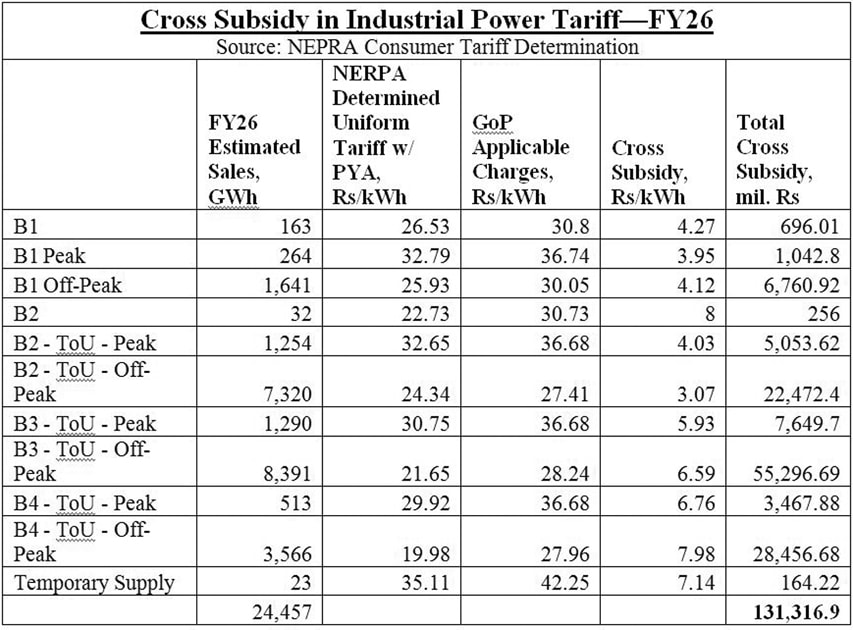
All the government must do is fix industrial tariffs at the regulator’s determined level and absorb the Rs 131 billion cross subsidy burden into its fiscal space.
The usual response is the lack of fiscal space, but the fiscal space is never there, it must always be found just as it was found to buy hundreds of cars for the FBR, to repeatedly increase bureaucrats’ salaries, and to rollback the digital presence tax following international backlash. If further avenues are required, the Federal Audit Reports 2024-25, released recently, are available on the Auditor General’s website.
It must be recognized that the country is out of options. Stabilization of macro indicators without real corrections on the ground has made the economy stagnant, with pressures now building on the exchange rate and interest rates, and no improvement in real-side indicators like the LSM index or exports. Improvement is impossible when the most basic input for manufacturing – energy — costs two to three times in Pakistan than in peer economies.
The only way forward is to remove the cross subsidy in industrial power tariffs, bring prices to competitive levels, and make the grid financially attractive. The government has already committed to the IMF to transfer power subsidies for low-income consumers to BISP by FY27; this process should be fast-tracked by relieving industrial consumers of the burden first.
Doing so will deliver multiple benefits: in the short term, it will stimulate baseload demand for the grid, easing the capacity cost burden for all consumers and creating a virtuous cycle of demand. It will provide cost relief not only to large exporters but also to B1 and B2 consumers—largely SMEs—who form the backbone of economies, drive innovation, and supply larger export firms.
Lowering energy costs will reduce barriers to entry, encourage new firms into manufacturing and exports, strengthen supply chains, promote domestic value addition, and support broad-based inclusive growth. This will also create the conditions to attract foreign investment into manufacturing (https:// www. brecorder.com/news/40379604) and support the development of a strong industrial base over the long term.
Without a fundamental realignment of power tariffs with cost of service, neither the power sector nor the economy can move forward.
Copyright Business Recorder, 2025

PUBLIC SECTOR EXPERIENCE: He has served as Member Energy of the Planning Commission of Pakistan & has also been an advisor at: Ministry of Finance Ministry of Petroleum Ministry of Water & Power
PRIVATE SECTOR EXPERIENCE: He has held senior management positions with various energy sector entities and has worked with the World Bank, USAID and DFID since 1988. Mr. Shahid Sattar joined All Pakistan Textile Mills Association in 2017 and holds the office of Executive Director and Secretary General of APTMA.
He has many international publications and has been regularly writing articles in Pakistani newspapers on the industry and economic issues which can be viewed in Articles & Blogs Section of this website.

























Comments
Comments are closed for this article.