


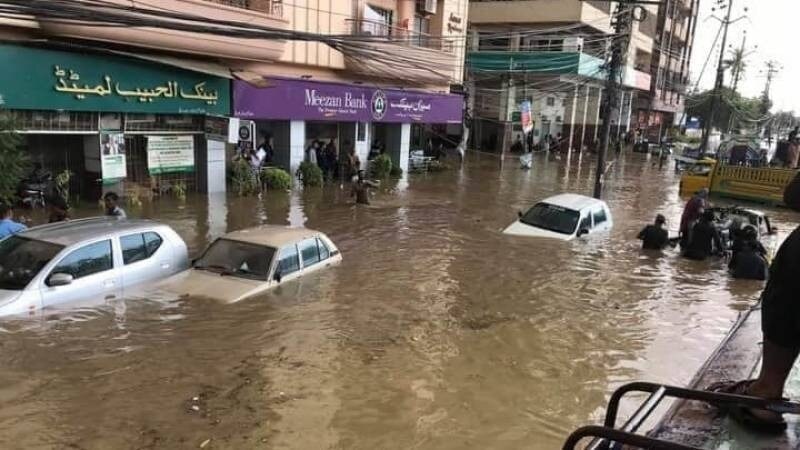

KARACHI: Relentless torrential rains have paralyzed Karachi, halting economic activity and causing an estimated Rs15 billion in losses for traders in just two days.
The deluge exposed the city’s crumbling infrastructure, with flooded streets, overflowing sewers, and thick sludge deterring customers and preventing shops from reopening.
The Pakistan Meteorological Department forecasts continued cloudy skies, intermittent rain, and thunderstorms for the next three days, signaling prolonged challenges for residents and businesses. The persistent adverse weather threatens to exacerbate the crisis, deepening the plight of the city’s commercial sector.
Torrential rains bring Karachi to a standstill
Across major markets, from the old city areas and Liaquatabad to other commercial hubs, shopkeepers attempting to resume operations were forced to close again. They faced a combination of labor shortages, power outages lasting over 24 hours in some cases, and impassable, filth-laden streets that kept customers away. The financial toll impacted everyone, from large wholesalers to small retailers, with perishable goods like fruits and vegetables spoiling due to lack of refrigeration.
Atiq Mir, Chairman of the All Karachi Tajir Ittehad, warned that the initial losses are only the beginning. Traders now face substantial repair costs for their waterlogged shops. He attributed the crisis to years of governmental neglect and criticized the decision to declare a public holiday, which prevented laborers from reaching workplaces and further crippled business operations.
The situation was worsened by a massive power breakdown. Neighborhoods such as Gulshan-e-Iqbal and Gulistan-e-Jauhar endured outages lasting over a day, prompting residents to block roads in protest. K-Electric, the city’s power provider, offered no explanation and remained unresponsive, with official contact lines reportedly switched off.
Karachi’s markets suffered immense damage as rainwater inundated shops in several commercial areas, destroying goods worth billions of rupees. The disruption persisted beyond the rainfall, with accumulated mud, overflowing sewers, clogged drains, and unsanitary streets continuing to deter customers.
“Traders now face enormous maintenance costs to repair and restore their waterlogged shops, draining millions more from their resources,” said Atiq Mir. He noted that partial business resumption on Wednesday morning quickly collapsed by midday due to absent laborers, reluctant customers, and ongoing power cuts. Mir also criticized Sindh Chief Minister Syed Murad Ali Shah for declaring a public holiday, arguing it prevented workers from reaching markets and forced shopkeepers to close without conducting any business. He warned that another term of the Pakistan Peoples Party (PPP) government could lead Karachi toward complete ruin.
Prolonged power outages plunged large parts of the city into darkness. Residents of Gulshan-e-Iqbal Block 5 and Scheme 33 reported 26-hour blackouts, while Gulistan-e-Jauhar faced an unprecedented 28-hour power cut. In Gulistan-e-Jauhar Block 19, electricity remained unavailable for 26 hours, leading residents to stage a protest at Johar Mor. Demonstrators blocked the road with barricades, causing a traffic jam stretching from Johar Chowrangi to Johar Mor, according to locals.
K-Electric provided no explanation for the extended outages, leaving citizens without access to fans, water pumps, or communication. Residents reported that the company’s spokespersons were unreachable, with official phone lines switched off.
Jamaat-e-Islami Karachi Chief Monem Zafar Khan held the PPP and Muttahida Qaumi Movement responsible for dismantling the city’s local governance system, leaving Karachi vulnerable to rain and civic failures. At a press conference, he demanded a Rs500 billion special package for the metropolis and Rs2 billion for each town to address the crisis.
The Provincial Disaster Management Authority warned of urban flooding, waterlogging in low-lying areas, and potential damage to vulnerable structures, urging authorities to remain on high alert. Recent rainfall data recorded 178 mm in Gulshan-e-Hadeed, 173 mm in Keamari, 163.5 mm in the Airport Old Area, and 58 mm in Hyderabad.
A public holiday was declared across Karachi Division on Wednesday, excluding essential services, with citizens advised to stay indoors. The Met Office predicted continued cloudy skies, intermittent rain, and thunderstorms over the next three days, with daytime temperatures ranging between 32 Celsius and 34 Celsius and high nighttime humidity.
Jamaat-e-Islami Karachi Chief, Monem Zafar Khan held the Pakistan Peoples Party and Muttahida Qaumi Movement responsible for ruining the city’s local body system and leaving Karachi defenseless against rain and civic breakdowns. Addressing a press conference, he demanded a Rs500 billion special package for the metropolis and Rs2 billion for each town to deal with the crisis.
Copyright Business Recorder, 2025

























Comments
Comments are closed for this article.