


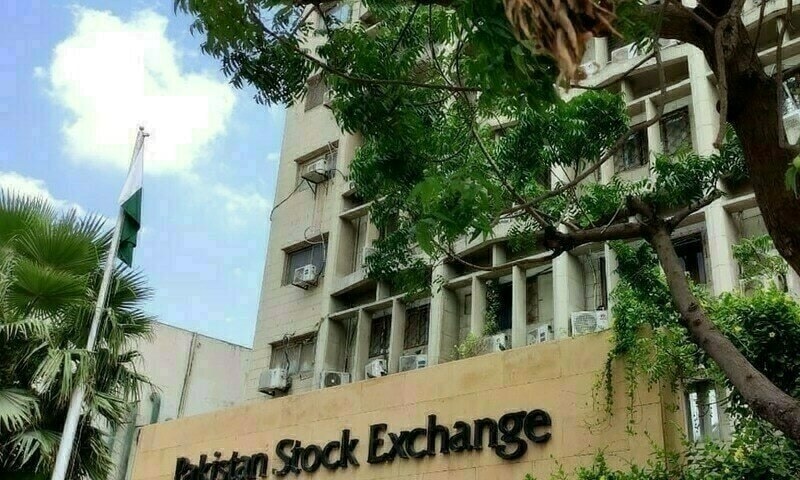

KARACHI: The Pakistan Stock Exchange (PSX) extended its bullish momentum this week, with the benchmark KSE-100 Index closing at a fresh all-time high of 134,299.77 points, after gaining a robust 2,351 points or 1.8 percent on a week-on-week (WoW) basis.
This marks another milestone in what has been a remarkable run for the local equity market, fuelled by improving macroeconomic fundamentals, sustained foreign inflows, and strong institutional participation.
PSX Market Capitalization also increased from Rs 15.910 trillion to Rs 16.288 trillion during the week — a gain of Rs 377.8 billion, or approximately 2.4 percent WoW in local currency terms.
BRIndex100 increased by 194.93 points last week, closing at 13,630.83 points. This is up from 13,435.90 points the previous week. On average, 733.196 million shares were traded daily for BRIndex100 which is less than 15 million shares from previous week.
BRIndex30 also rose by 433.66 points over the week, ending at 39,850.99 points while it ended up previous week at 39,417.33 points. The average daily trading volume for BRIndex30 during the week remain 403.526 million shares
According to market observers, this week’s rally was primarily driven by continued buying from local mutual funds amid new allocations, with the month-to-date (MTD) net inflows from this segment standing at around US$30 million by Thursday’s close.
The persistent institutional interest provided stability and upward momentum to the index, even as overall trading volumes moderated slightly compared to the previous week.
Contributing to the positive sentiment were several key macroeconomic developments. Remittances for June 2025 came in at a solid US $3.4 billion, taking the cumulative figure for FY25 to a historic US $38.3 billion, the highest ever annual remittance inflow recorded by Pakistan and up 27 percent year-on-year (YoY). This surge provided a crucial cushion to the external account and underpinned the rupee’s stability in recent sessions.
In the money market, robust participation of Rs 2.7 trillion was recorded in the latest T-Bill auction, where the government raised Rs 1.41 trillion. Notably, the yield on the 12-month T-Bill declined by 13 basis points, signalling improved investor confidence and easing inflationary concerns.
Another positive trigger for the equities market was the latest data from the State Bank of Pakistan (SBP), which showed that foreign exchange reserves surged to a 39-month high of US $14.5 billion for the week ended July 4, 2025. This sharp increase, coupled with record remittances, pushed total reserves past the US $20 billion mark for the first time in three years, significantly strengthening Pakistan’s external position.
The government’s fiscal management efforts also remained in focus as authorities successfully retired Rs 1.5 trillion in public debt ahead of schedule in FY25, bringing the country’s debt-to-GDP ratio down to 69 percent from 75 percent in FY23. Additionally, the government advanced plans to issue its inaugural Panda bond in the Chinese capital market, with key meetings held in China this week to finalize arrangements.
Among sectors, the automobile industry continued its impressive recovery, as compare to the last some years, benefiting from improved stability and consumer sentiment.
According to figures released by the Pakistan Automotive Manufacturers Association (PAMA), car sales in June 2025 soared to 21,773 units, reflecting a 64 percent YoY increase and a 47 percent MoM rise. On a cumulative basis, industry sales during FY25 rose by 43 percent YoY to 148,019 units, marking one of the sector’s strongest yearly performances in recent history.
A sector-wise breakdown showed Textile companies leading the gains with a 10.5 percent WoW rise, followed by chemicals (up 6.8 percent), autos (up 4.2 percent), and banks (up 3.6 percent). Cement, pharmaceuticals, and engineering stocks also posted steady gains amid improving demand outlook and healthy corporate earnings expectations.
In terms of market activity, average daily traded volume stood at 948 million shares, while the average daily traded value clocked in at Rs 38.8 billion during the outgoing week. While these figures represented a marginal decline compared to last week, analysts contended that overall sentiment remained buoyant, supported by sustained institutional flows and robust corporate disclosures.
Among individual stocks, BNWM (Bannu Woollen Mills) MEHT (Mehmood Textile Mills), and KTML (Kohinoor Textile Mills) were the top gainers, posting gains of 34.0 percent, 26.7 percent, and 18.6 percent WoW respectively. On the other hand, PSEL (Pakistan Services Limited), AIRLINK, and PKGP faced profit-taking pressures.
Regionally, Asian markets displayed a mixed performance. Korea’s KOSPI led with a 4.0% gain, followed by Indonesia (up 2.7%) and China (up 1.1%), while India’s Sensex fell by 1.1% amid geopolitical jitters and mixed earnings guidance. In contrast, the PSX’s 2 percent increase on a week on week basis, highlighted its relative resilience and appeal among frontier and emerging markets.
With a combination of record remittances, improving external reserves, controlled inflationary outlook, and fiscal consolidation, market analysts anticipate the PSX’s positive trajectory to persist in the near term. However, they caution that intermittent profit-taking and global market volatility could inject bouts of volatility.
Sectors likely to remain in investor focus include banking, autos, textiles, and export-oriented industries, while institutional flows — particularly from mutual funds and foreign portfolio investors — are expected to remain the key market drivers.
Copyright Business Recorder, 2025




















Comments
Comments are closed for this article.