


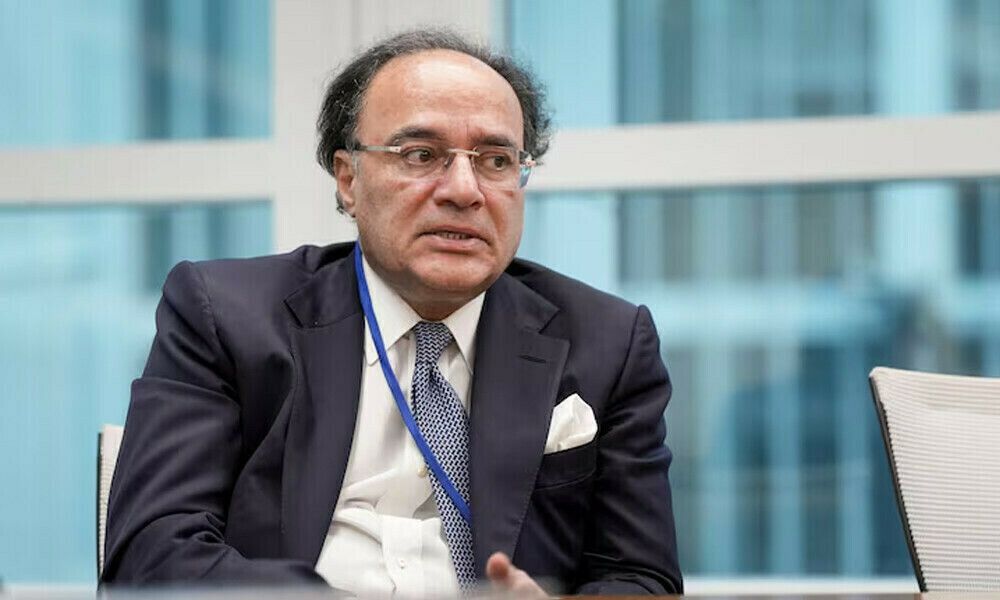

Finance Minister Muhammad Aurangzeb has called for the population to be recognised as a core allocation criterion in the National Finance Commission (NFC) Award.
The minister made these remarks at an event organised by the Ministry of National Health Services, Regulations and Coordination at a local hotel in Islamabad today, in observance of World Population Day.
He agreed with the views expressed by the Health and Planning Ministers, advocating for the inclusion of broader human development indices to guide equitable resource distribution between the federation and provinces.
The NFC Award in Pakistan is a mechanism for distributing financial resources between the federal government and the provinces. It’s established by Article 160 of the Constitution and involves a formula-based allocation of taxes and other revenues.
Senator Aurangzeb also called for a reorientation of donor engagement and development financing.
He remarked that while infrastructure had been the primary recipient of international funding in the past, it is now imperative to direct those resources toward human capital development, particularly in health, education, and population planning.
Conflict with India won’t have large fiscal impact, says Aurangzeb
“If we want to realise the dream of being a $3 trillion economy by 2047, we have to deal with two existential issues, i.e. climate change and population growth,” said Aurangzeb.
Aurangzeb drew attention to Pakistan’s population growth rate of 2.55% and its alarming implications for national development, economic planning, and social well-being.
“40% of the children, below the age of five in Pakistan, suffer from stunted growth,” he said.
Aurangzeb warned that the country’s future leadership is already at risk. He stressed that addressing stunting and learning poverty requires an integrated, end-to-end approach, encompassing nutrition, sanitation, clean drinking water, birth spacing, and greater awareness—all of which were discussed by scholars and experts at the event.
Similarly, a large chunk of the population, especially females, remains deprived of literacy, said Aurangzeb.
“Females account for at least 50% of the population; if they don’t become a productive part of the workforce, then this country cannot move forward in a sustainable way,” he said.
He emphasised the need for a paradigm shift in national budgeting. Rather than compartmentalising federal and provincial finances, he proposed a unified, country-level approach to development spending.
Citing this year’s development budget of Rs1 trillion at the federal level and Rs4.2 trillion when including provinces, he noted that the real challenge is not the availability of funds but their optimal allocation and prioritisation.
He referenced Pakistan’s 10-year Country Partnership Framework with the World Bank, noting that four out of its six pillars focus on population and climate-related issues. He informed the gathering that one-third of the total funding—amounting to nearly $20 billion over a decade, or around $600–700 million annually—will be dedicated to population-related measures.
He urged that such resources must be strategically deployed, moving beyond symbolic steps like tax relief on contraceptives, and instead ensuring impactful investments across the board.

























Comments
Comments are closed for this article.