


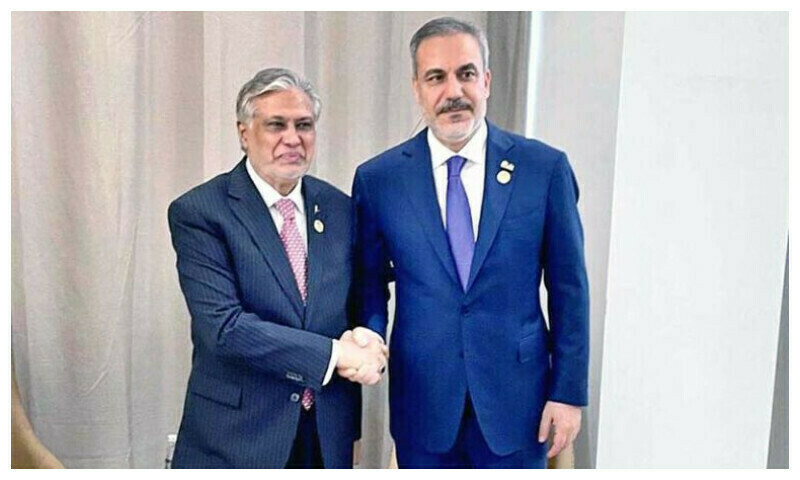
Pakistan and Türkiye on Wednesday reaffirmed their resolve to deepen strategic and economic cooperation, targeting a bilateral trade volume of $5 billion in the coming years, state-run APP reported.
The understanding came during the visit of Turkish Foreign Minister Hakan Fidan and Minister of National Defence Yasar Güler to Islamabad. They held meetings with Pakistan’s Deputy Prime Minister and Foreign Minister Ishaq Dar under the framework of the High-Level Strategic Cooperation Council (HLSCC).
According to a statement issued by the Ministry of Foreign Affairs, both sides reiterated the historic and brotherly nature of Pakistan-Türkiye relations, rooted in shared history, culture, and faith.
Dar appreciated the growing momentum in bilateral cooperation and emphasized the need to further expand collaboration in areas such as trade, investment, and energy.
Top Turkish officials to visit Pakistan Wednesday, source says
Fidan, delivering greetings from Turkish President Recep Tayyip Erdoğan, reaffirmed Ankara’s commitment to enhancing the multifaceted partnership with Islamabad.
The visit also marked the inaugural session of the Joint Commission under the HLSCC, co-chaired by the two foreign ministers. “All twelve Joint Standing Committees working under the HLSCC framework have either met or are scheduled to meet soon,” the MoFA statement noted, terming this a sign of concrete progress on earlier commitments.
In addition, preparations are underway for the upcoming session of the Joint Ministerial Commission (JMC), which will be co-chaired by Turkish Defence Minister Yaşar Güler and Pakistan’s Minister for Commerce Jam Kamal Khan. The platform is expected to further bolster economic and sectoral cooperation between the two countries.
The leaders also exchanged views on regional and international developments and reaffirmed their shared commitment to peace, stability, and development in the region.
The sustained high-level engagement, both countries noted, reflects a shared resolve to transform strategic goodwill into tangible outcomes through institutional mechanisms.












Comments
Comments are closed for this article.