


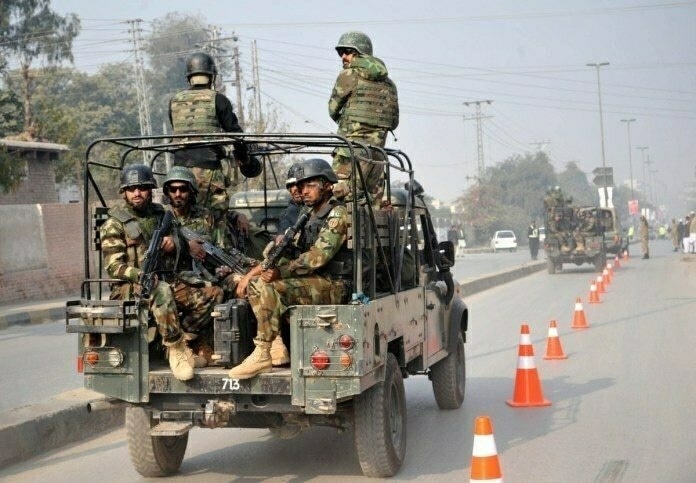
EDITORIAL: The IED blast in Bajaur on Wednesday, which claimed the life of Assistant Commissioner Fawad Ali and four others, is yet another tragic reminder of the relentless and ever-present threat that terrorism poses to Pakistan.
The so-called Tehreek-e-Taliban Pakistan (TTP) has claimed responsibility, but this attack is only one part of a brazen strategy of hybrid warfare being waged against Pakistan — a strategy directed by India as part of the Modi government’s declared doctrine of ‘offensive defence.’
India’s involvement in destabilising Pakistan, of course, is not confined to just the TTP. It has consistently backed militant groups, including the Baloch Liberation Army (BLA), and other proxies. By doing so, it has pursued a calculated strategy of keeping Pakistan under constant pressure through the export of terror via non-state actors.
Only a few months ago, the BLA publicly assured India that should it choose to confront Pakistan, the group and its affiliates would be ready to engage from the western border, positioning itself as New Delhi’s “practical and military arm.”
This covert campaign to destabilise Pakistan is not limited to proxy warfare. India’s actions have increasingly extended beyond its borders, targeting individuals for extrajudicial killings. In June 2023, Indian agents assassinated prominent Sikh separatist leader Hardeep Singh Nijjar in Vancouver, sparking a massive political uproar. Canada officially accused Indian diplomats of being complicit in “criminal” activities on Canadian soil.
This was followed by the foiling of another Indian plot in New York, aimed at killing another Sikh leader. The list of India’s extraterritorial operations extends to the assassination of 20 Kashmiri and Sikh dissidents inside Pakistan. There is irrefutable evidence linking India to these and various other acts of terror — from Bajaur to Balochistan, and from Vancouver to New York.
Yet, India continues to present itself as a victim of terrorism while portraying Pakistan as the perpetrator. Since the April 22 Pahalgam massacre in occupied Jammu and Kashmir, India has been trying to paint that picture of Pakistan. However, its narrative has faced significant setbacks.
At the recent Shanghai Cooperation Organisation (SCO) defence ministers’ meeting in China, member states unanimously refused to include the Pahalgam incident in the joint communiqué and instead highlighted terrorism in Balochistan. Similarly, during the Quad Foreign Ministers’ meeting in Washington, the US State Department’s joint statement refrained from naming Pakistan or attributing blame to it for the Pahalgam attack.
Moving forward, as suggested by PPP leader and former foreign minister Bilawal Bhutto-Zardari at a recent conference in Islamabad, Pakistan and India need to “forge a historic, phenomenal partnership” to jointly combat terrorism. This partnership, he emphasised, should not be shaped by adversarial rivalry, but by a shared moral and civilisational obligation to save a billion souls from the plague of extremism. Unfortunately, however, as long as the ultra-Hindu nationalist Narendra Modi remains at the helm, it is highly unlikely that New Delhi will change its course or abandon its destructive policies.
Copyright Business Recorder, 2025

























Comments
Comments are closed for this article.