


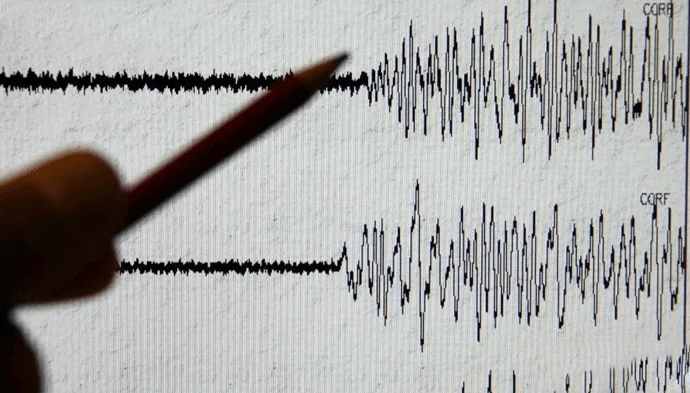

KARACHI: A series of low-magnitude earthquakes shook Karachi on Sunday and Monday, sparking widespread concern among residents in the city’s eastern and southeastern districts.
The tremors, which occurred in quick succession, led to the evacuation of homes, disruption of industrial activities, and heightened public anxiety across several neighbourhoods.
The Pakistan Meteorological Department (PMD) recorded six seismic events over the two-day period. The first quake struck on Sunday, June 1, at 5:33 PM with a magnitude of 3.6 and a depth of 10 kilometres, centred near Quaidabad.
On Monday, June 2, five additional quakes followed, ranging between magnitudes 2.2 and 3.2. Epicentres were reported near Quaidabad, Gadap Town, and southeast of Malir, with depths varying from 10 to 188 kilometres.
Tremors were felt in Landhi, Malir, Shah Faisal Colony, Korangi, Bhains Colony, Shah Latif Town, and surrounding areas. In multiple neighbourhoods, residents fled their homes, some reciting prayers in fear of aftershocks. In Majeed Colony and Muzaffarabad Colony, back-to-back tremors within a 10-minute span led to public announcements from mosques urging calm.
In the industrial zone of Landhi, textile and manufacturing units declared emergency leave and suspended operations. Factory owners cited safety concerns amid ongoing seismic activity, advising workers to return home and remain cautious. The decision was praised by civic groups, though it highlighted the deep unease felt throughout the city.
Speaking to the media, Chief Meteorologist Karachi, Amir Hyder Laghari offered insight into the nature of the tremors: “When a local fault becomes seismically active, it releases built-up tectonic stress in the form of frequent, low-magnitude tremors. The more energy it releases over time, the lower the likelihood of larger, sudden earthquakes.”
He elaborated on the geological behaviour of Karachi’s fault line, stating: “The fault system in Karachi gradually accumulates energy, and when this energy is released, we observe a series of quakes of varying magnitudes. Typically, minor tremors subside within a couple of days, whereas stronger quakes can take longer to stabilize.”
Addressing concerns about potential major quakes, Laghari reassured the public: “Historically, Karachi’s fault line has never produced large-scale earthquakes. The region primarily experiences minor seismic activity due to its strike-slip tectonic setting involving the Indian, Arabian, and Eurasian plates. This configuration generally does not generate destructive quakes in the Karachi region.”
However, he warned that areas outside Karachi—particularly along the Makran Subduction Zone in coastal Balochistan—present more serious risks:
“The Balochistan offshore fault lies along the boundary of the Eurasian and Arabian plates and is part of a subduction zone. This geological structure poses a higher risk, including the potential to generate tsunamigenic earthquakes. Since the major Makran earthquake of 1945, no large events have occurred in the region, though its tectonic nature suggests it remains capable of future seismic activity.”
In affected localities, such as Khokhrapar, Future Morr, Gul Ahmed, Hospital Chowrangi, and Saudabad, residents are now calling for clearer safety protocols and better early-warning systems. As PMD continues to monitor seismic behaviour, the people of Karachi remain alert, hoping the ground beneath them settles soon.
Copyright Business Recorder, 2025




















Comments
Comments are closed for this article.