




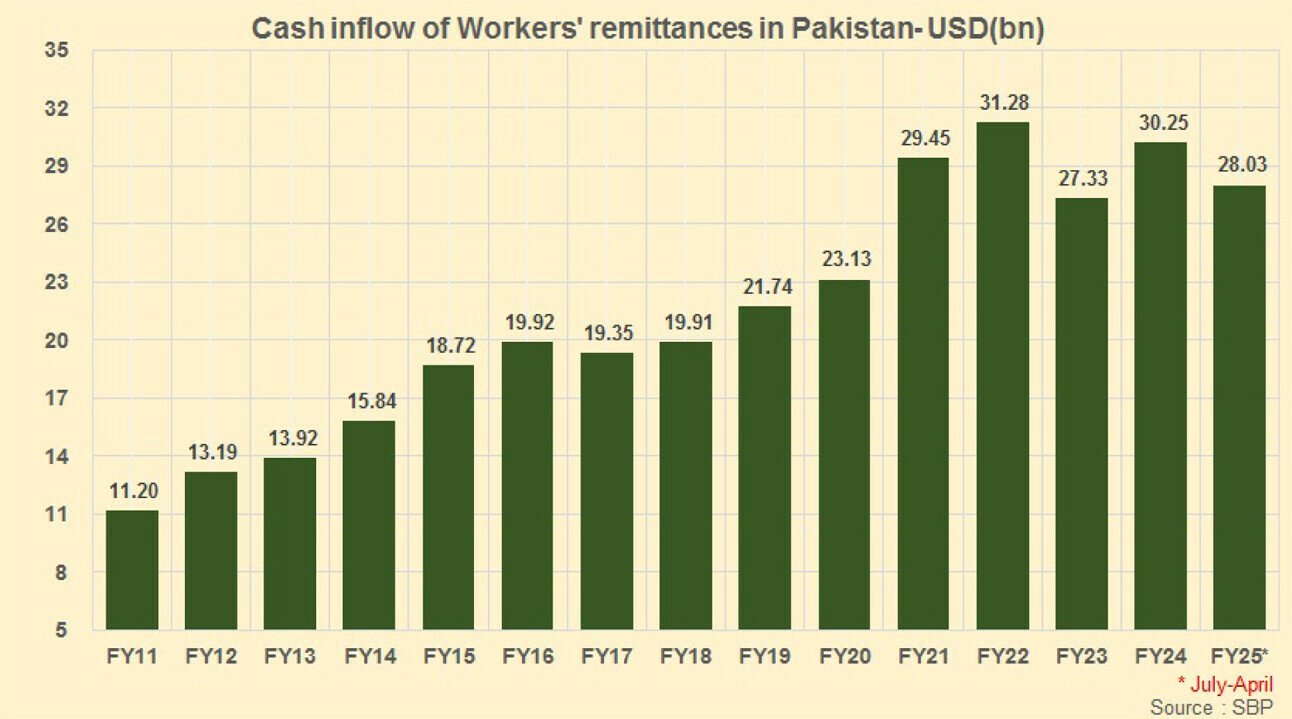
Remittances to Pakistan reached an all-time high of $31.2 billion during the first ten months of FY25 (10MFY25), registering a remarkable 31 percent year-on-year increase from $23.9 billion in the same period last year.
The surge marks a critical lifeline for the country’s fragile external account and underscores the economic resilience of the overseas Pakistani community. However, despite the cumulative strength, there was a sharp decline in inflows during April 2025—down 22 percent month-on-month.
March’s spike was widely attributed to seasonal factors linked to Ramadan and Eid-related transfers.
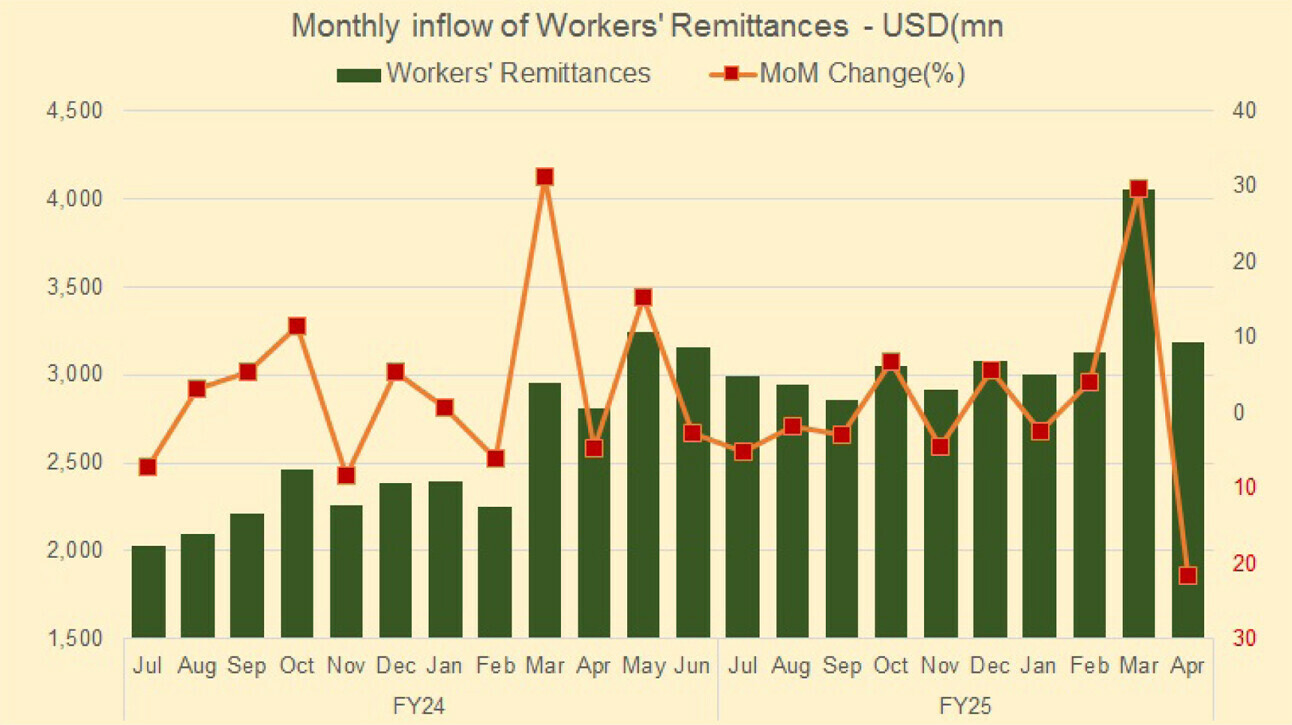
The April drop, while expected in part, was deeper than forecast and is raising fresh concerns over the sustainability of remittance momentum in the months ahead. Year-on-year, April 2025 still reflected a healthy 13.1 percent growth, showing that the overall trend remains positive. Yet the volatility suggests the need for policy vigilance.
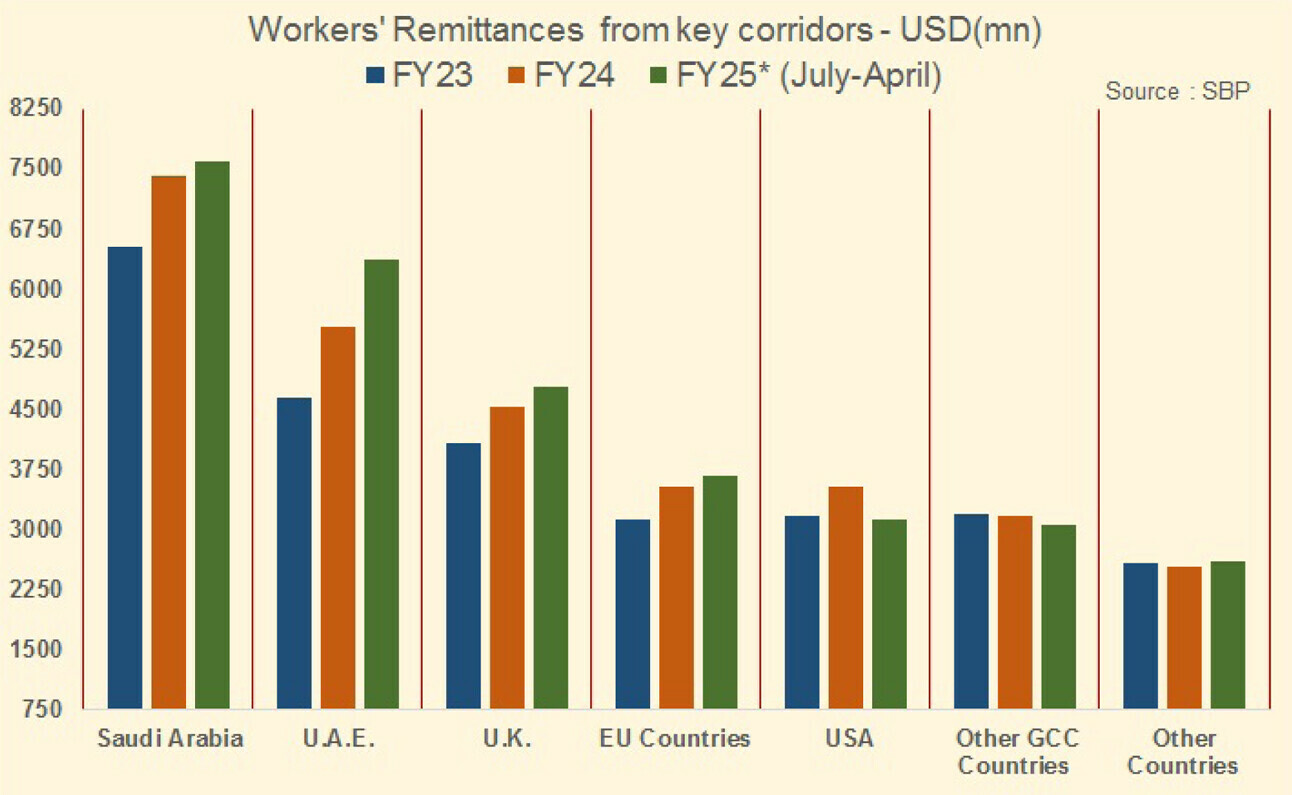
Saudi Arabia and the United Arab Emirates remained the two largest corridors. Saudi Arabia contributed $7.6 billion in 10MFY25, followed by the UAE at $6.36 billion. Inflows from the United Kingdom stood at $4.78 billion, and the United States contributed $3.12 billion. These four corridors together accounted for over two-thirds of Pakistan’s total remittances.
The growth in formal channel flows is supported by improved compliance measures, narrowing of the gap between official and open market exchange rates, and expanded access to digital remittance channels. Programs such as the Roshan Digital Account and Raast have also played a role, although their adoption may now be plateauing.
Recent economic recovery has also fuelled growth in remittances. According to an ADB Working Paper, macroeconomic variables in both sending and receiving countries significantly shape remittance flows to Pakistan. The study found that economic activity abroad—especially in the Gulf and Western economies—remains a strong driver of remittance inflows.
Migrants tend to remit more when their income prospects are strong. Then, domestic inflation in Pakistan consistently boosts remittance flows, reflecting a compensatory motive where migrants support their families against rising prices.Surprisingly, domestic interest rates have a delayed positive impact on remittances, suggesting that higher returns at home eventually attract greater financial inflows.
Finally, the oil prices are positively associated with remittance growth, particularly from Saudi Arabia. When oil revenues rise, Gulf economies experience employment, and wage gains that cascade into higher remittances.
However, the report also highlights that the structural and persistent drivers—such as diaspora size, cost of transfer, and cultural remittance habits—remain dominant. This implies that remittances tend to persist even in the face of macroeconomic fluctuations, though their growth rate may vary.
Looking ahead, Pakistan’s full-year FY25 remittances are likely to exceed $36 billion, barring major external shocks. However, in the coming months, a softening of economic activity in the Gulf, rising inflation in host countries, and reduced incentives through formal channels could all weigh on inflows in the final two months of FY25. Additionally, the stabilizing exchange rate may reduce the urgency to remit early or through official banking routes.




















Comments
Comments are closed for this article.