




SHANGHAI: China’s yuan hit a two-week low against the dollar on Monday on growing investor concerns about trade disputes between the world’s two largest economies as the deadline for US President Donald Trump’s reciprocal tariffs approaches.
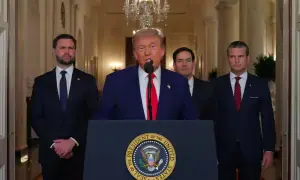
Developments in trade relations with the United States have been front and centre of investors’ minds. Trump still intends to impose new reciprocal tariffs on a number of US trading partners on April 2, the White House said last week.
However, in contrast to a volatile greenback, the yuan has been mostly stable, swinging in a narrow range of about 1% so far this month.
President Xi Jinping’s plan to make the yuan the cornerstone of China’s financial strategy has helped limit downside for the currency, while 20% tariffs under the Trump administration have capped its upside, some market watchers said.
“Beijing wants neither a strong nor weak yuan,” said Marc Chandler, chief market strategist at Bannockburn Global Forex.
China’s yuan slips to one-week low, looks set for weekly drop
“It wants a broadly stable one against the US dollar. One set of reasons why the People’s Bank of China (PBOC) has been reluctant to cut rates may be related to the exchange rate.”
Analysts at Galaxy Securities echoed the view and said the priority of monetary policy has shifted to financial stability and exchange rate stability as uncertainties from external environment rose.
“In the short term, the foreign exchange market has a higher priority,” they said in a note, after the central bank on Friday reiterated its intention to strengthen the resilience of the FX market.
The onshore yuan eased to a two-week low of 7.2615 per dollar before paring some losses to trade at 7.2590 as of 0304 GMT, when its offshore counterpart traded at 7.2630.
Prior to the market opening, the PBOC set the midpoint rate , around which the yuan is allowed to trade in a 2% band, at 7.1780 per dollar, its weakest since January 20 and 716 pips firmer than a Reuters’ estimate of 7.2496.
Separately, China sought to reassure foreign corporate chiefs of the country’s business potential and Premier Li Qiang urged countries to open up their markets to combat “rising instability and uncertainty” at an annual business forum in Beijing, as China braces for further US tariff headwinds.
















Comments
Comments are closed for this article.