


China ramps up stimulus to guard economy from changes ‘unseen in a century’


BEIJING: China unlocked more fiscal stimulus on Wednesday, promising greater efforts to support consumption and cushion the impact of an escalating trade war with the United States on an economy that Beijing is determined to grow by another 5%-or-so this year.
Premier Li Qiang, in a speech at the opening of the annual meeting of China’s parliament, warned that “changes unseen in a century are unfolding across the world at a faster pace”.
“An increasingly complex and severe external environment may exert a greater impact on China in areas such as trade, science, and technology,” Li said.
The trade war with US President Donald Trump’s administration is threatening China’s economic jewel, its sprawling industrial complex, at a time when persistently sluggish household demand and the unravelling of the debt-laden property sector are leaving the economy increasingly vulnerable.
Trump has also dangled tariffs at a long list of countries, disrupting a decades-old global trade order that Beijing has built its economic model around.
Pressure has been building on Chinese officials for consumer-focused stimulus to fend off deflationary pressures and reduce the world’s second-largest economy’s reliance on exports and investment for growth.
The term “consumption” was mentioned 31 times in Li’s report, up from 21 times last year, while “technology” received 28 mentions, slightly up from 26 in 2024, according to Guotai Junan analysts.
“For the first time, boosting consumption has been elevated to the top priority among 2025’s major tasks, displacing technology from its usual leading position,” said Tilly Zhang, technology analyst at Gavekal Dragonomics.
“It’s not a pivot from the previous industrial policy, but pursuing a more balanced” macroeconomic framework, Zhang said.
However, China said more than a decade ago that it wants to shift to a more consumer-driven growth model, without making significant progress towards that goal, and investors aren’t placing bets on this change in tone.
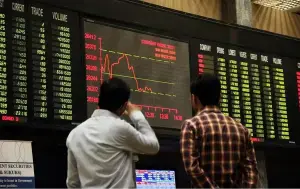
The CSI AI Industry Index gained 1.1% and the Hang Seng Tech Index climbed 3%. The consumer discretionary sector rose 0.6%.
The recent emergence of artificial intelligence platform Deepseek has boosted market sentiment in China this year.
AI advancement was given more space in Li’s speech this year compared with 2024, with promises to foster its application in sectors including electric vehicles, smartphones and robots.
The roughly 5% growth target for 2025 and a larger budget deficit plan of around 4% of economic output that Li presented to parliament confirmed a December Reuters report.
Li also said Beijing plans to issue 1.3 trillion yuan ($179 billion) in ultra-long special treasury bonds this year, up from 1 trillion yuan in 2024. Local governments will be allowed to issue 4.4 trillion yuan in special debt, up from 3.9 trillion yuan.
Separately, Beijing plans to raise 500 billion yuan to re-capitalise major state banks.
Analysts say the higher debt and spending figures aim to cushion the impact of tariffs.















Comments
Comments are closed for this article.