


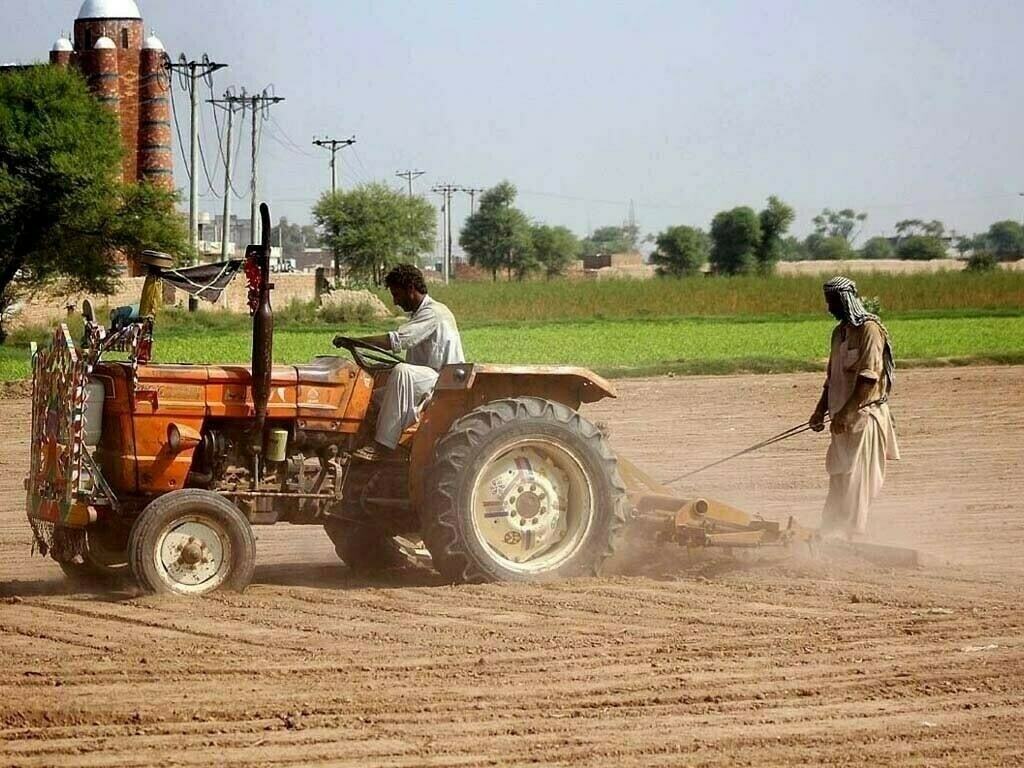
EDITORIAL: Punjab Chief Minister Maryam Nawaz’s recent push for agricultural mechanisation is a long-overdue but welcome step. For far too long, Pakistan’s agricultural sector has remained shackled by outdated practices, while its counterpart across the border in Indian Punjab has surged ahead by embracing modern technology.
This stark difference in approach has resulted in a significant disparity in agricultural productivity, with Indian Punjab achieving far higher yields, greater efficiency, and better resource management. If Pakistan is serious about food security and economic stability, the mechanisation of agriculture cannot be treated as a token initiative — it must become a national priority.
Punjab, the country’s agricultural heartland, is still stuck with antiquated farming techniques that waste both time and resources.
While Indian farmers have adopted modern irrigation systems such as drip irrigation, precision farming, and automated harvesting, Pakistani farmers continue to rely on outdated flood irrigation methods that result in excessive water wastage and lower crop yields.
The consequence is an ever-widening gap in agricultural output. The same land, same climate, and largely similar crops produce vastly different results simply because of the technological choices made on either side of the border.
The chief minister’s remarks recognizing mechanisation as “just the beginning” should be taken as an acknowledgment that the current state of agriculture in Pakistan is unsustainable.
The world has moved on from traditional farming methods, yet our farmers remain caught in a cycle of inefficiency, largely due to a lack of awareness, financial constraints, and poor policymaking.
Subsidies and incentives for mechanised farming have been sporadic at best, and there has been little effort to train farmers in adopting modern techniques. Without a comprehensive, well-funded programme to support mechanisation, mere political rhetoric will not be enough to bridge the gap.
The key takeaway is that agricultural progress is not just about using more machines — it is about smart farming. Indian farmers have not only adopted machinery like combine harvesters and precision planters but have also embraced data-driven agriculture, which optimises inputs like water, fertilisers, and pesticides.
In contrast, Pakistan’s farming community still operates largely on guesswork, leading to inefficiencies, lower yields, and higher production costs. If Pakistan is to compete, it must implement policies that make modern farming accessible to all, not just to large landowners who can afford it.
One of the most critical aspects of mechanisation is irrigation. Pakistan’s outdated canal-based irrigation system leads to enormous water losses, while Indian farmers have successfully integrated drip and sprinkler irrigation systems that maximise water efficiency.
Given Pakistan’s looming water crisis, this is an area that requires immediate intervention. The government must not only promote but actively subsidise modern irrigation techniques, ensuring that farmers see tangible benefits in adopting them.
If the chief minister’s commitment to mechanisation is genuine, it must be backed by large-scale investment in agricultural technology, farmer training programmes, and financial incentives for those willing to modernise their practices.
The cost of inaction is clear: stagnation, declining productivity, and increasing reliance on food imports. The disparity between the two Punjabs should serve as a wake-up call — modern agriculture is not a luxury; it is a necessity. It is time Pakistan catches up before it is too late.
Copyright Business Recorder, 2025




















Comments
Comments are closed for this article.