



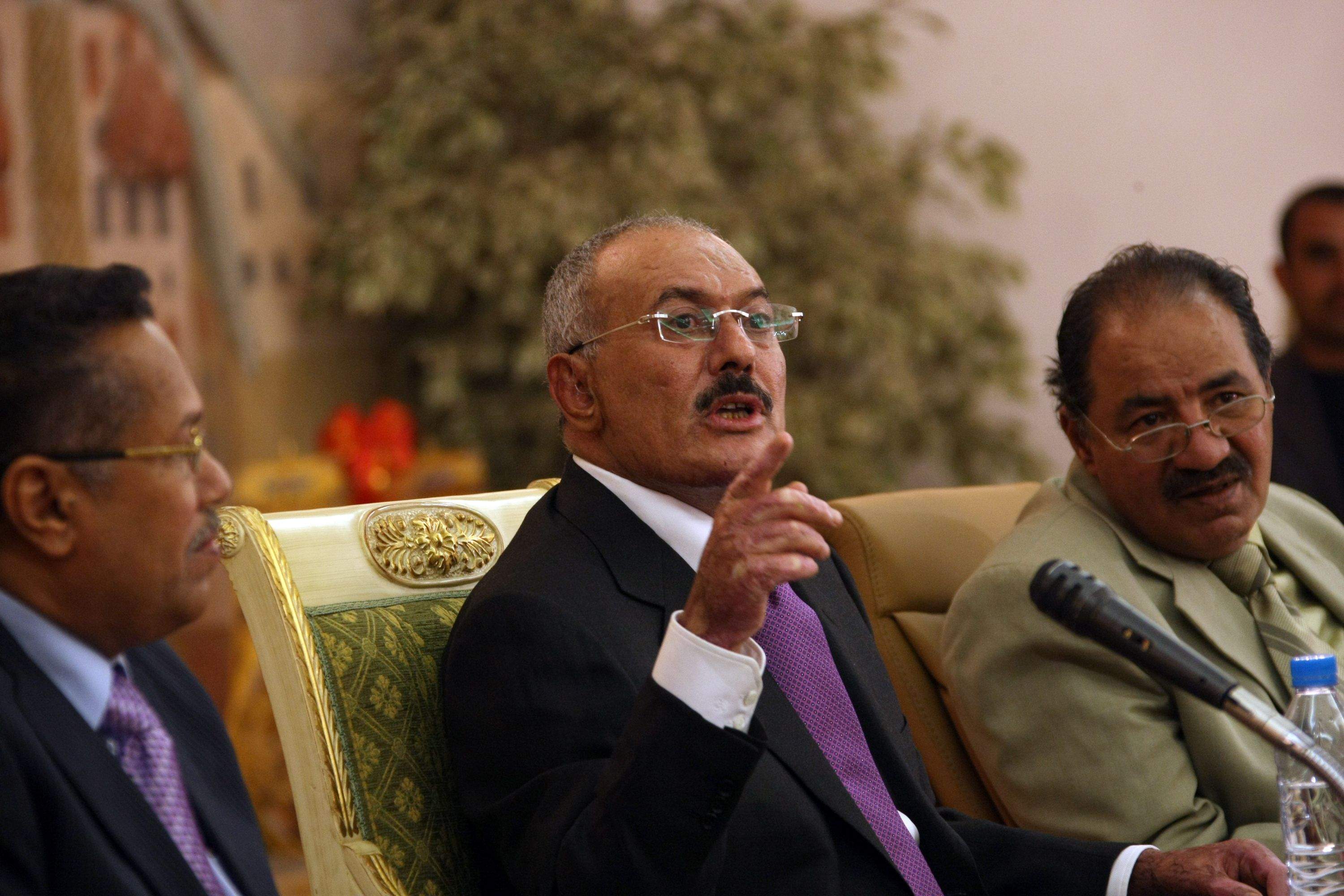
 SANAA: Security forces and backers of Yemen's embattled President Ali Abdullah Saleh shot dead seven protesters on Saturday, as Saleh said he would soon visit the US ahead of transferring power in February.
Dozens more demonstrators were hurt when tear gas and water cannons were used against thousands of marchers demanding that Saleh face trial, witnesses and medics said.
"Four of the dead were taken to the field hospital" at Change Square in Sanaa, the epicentre of anti-regime protests in the capital, the facility's director, Mohammed al-Abbahi, told AFP.
Saleh has faced waves of protests since January demanding an end to his 33-year-regime, and the resulting crackdown by his security forces has left hundreds of people dead.
The veteran strongman has agreed to stand down following a February 21 presidential election, but some of his opponents are furious that Saleh has secured an immunity deal as a condition for his departure.
The objective of the "March for Life" that turned deadly on Saturday was to press for Saleh and his top allies to face criminal charges for their roles in the crackdown on anti-regime protesters.
All of those killed Saturday had been shot, said Abbahi, who added that "dozens of wounded have been admitted to different medical centres."
Tens of thousands of protesters who set off from the southern city of Taez on Tuesday for the 270-kilometre (167-mile) march to the capital had arrived in Sanaa in mid-afternoon but were blocked in a southern suburb.
Government forces blocked the streets leading to Sabine Square, adjacent to the presidential palace, where Saleh loyalists have previously gathered on Fridays to voice support for the veteran leader.
Speaking not far from the scene of the violence, Saleh said he will travel to the United States in the coming days:
"Not for treatment, because I am well, but in order to create favourable conditions... for the presidential election," set for February 21, he told a news conference in Sanaa.
Saleh, who was wounded in a June 3 explosion at his Sanaa palace and airlifted to hospital the next day in Saudi Arabia, needs "important" medical treatment abroad, Jamal Benomar, the UN envoy in Yemen, said on Wednesday.
The national unity government, headed by the opposition, that is leading a three-month transition period before the February polls, on Saturday unveiled its programme and made clear the impoverished country needs urgent help.
"The government is going to try to convince its brother countries and friends to create a special international fund for Yemen," Prime Minister Mohammed Basindawa told parliament, according to the official Saba news agency.
Many Yemenis face severe food shortages, months of political tension have devastated public services that were already weak, and government forces have not been able to stamp out an Al-Qaeda-linked insurgency in the restive south.
Basindawa said the new funds would be spent to ensure Yemenis had an adequate supply of oil, gas, water and electricity, but offered no specifics on where the money would come from.
He also pledged to provide aid to the families of the "martyrs" killed during the year of unrest.
But despite the political deal brokered by the Gulf Cooperation Council (GCC) that charts the path for Saleh's departure, the unrest has showed no signs of abating.
The tens of thousands who braved the streets of Sanaa and Taez to demand regime change have in part returned to denounce the GCC deal, demanding that Saleh and his loyalists be held accountable for their roles in violently suppressing dissent.




















Comments
Comments are closed for this article.