


Each year on 22 April symposiums, seminars and conferences held world-wide to celebrate Earth Day. The first Earth Day held on April 22, 1970, the aim was to promote ideas of ecology, to encourage respect for life on earth, and to highlight growing concern over pollution of the soil, air, and water.
Organisers of the first celebration wrote in their manifesto "Earth Day is a commitment to make life better, not just bigger and faster, it is a day to re-examine the ethic of individual progress at mankind's expense." Issues, affecting quality of living on earth highlights on Earth day. Air pollution, water pollution, the dumping of toxic chemicals and the destruction of natural habitat are rapidly changing the rhythms of climate. The biggest challenge for humanity is now to slow down climate changes and to save earth from further destruction.
No doubt, changes in earth climate is not new, volcanic eruptions, ocean current, the earth's orbital changes and solar variations are natural causes of climate changes ( storm, earthquakes, Tsunami Flood etc) for millions of years. However, climate changes occurring today have been speeded up because of disastrous human activities. The recent rise in temperature over the last century is different to previous climatic change because it involves a new forcing: greenhouse gas emissions from human activity, which has driven atmospheric CO2 to its highest level for 15m years. Using climate models, scientists have shown that natural forcing alone cannot account for the rise in average global temperature. However, the temperature rise does fit with what scientists would expect from a mixture of natural and human forcings.
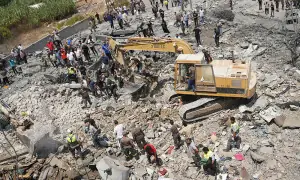
Over the past decade, countries across the world have witnessed thousands of major natural disasters caused enormous death tolls and shattering of millions of homes. World disaster report 2010 states "Earthquakes killed the most people over the period from 2000 to 2008 - an average of 50,184 people a year. Floods, meanwhile, have affected the largest number of people - an average of 99 million people a year. The most costly urban disaster of the last decade was the Bam earthquake in Iran, in 2003, which left damages totalling US $500m. The deadliest disaster was the South Asian tsunami in 2004, which affected seven countries and killed 226,408".
The major natural disasters are Japan earth quake ( 11 March 2011), Haiti earthquake ( 10 January 2010), Kashmir earthquake ( 8 October2005), Hurricane Katrina ( 29 August 2005)South Asian Tsunami ( 26 December 2004)European Heat wave, ( summer 2003), Dresden flood(11 August 2002) Gujarat earthquake ( 26 January 2001). There is a direct connection between earthquake and climate change. Huge ice sheets 'glue' the land underneath them together. This prevents earthquakes happening because the power of the earthquake would not be enough to overpower the force of the ice, which is holding the land together. A new study has found that melting ice sheets can release pent-up energy and trigger massive earthquakes.
Scientific research and climatologists have already warned that natural disasters are likely to increase both in number and in scale due to climate changes. Humankind has to be prepared for these changes, since it seems as though they are inevitable. Jim Hansen - eminent climate scientist and director of NASA's Goddard Institute for Space Studies - warns that we could see a one to two meter rise this century and several more in the next. Other climate scientists too, forecast substantially greater rises. A worst-case scenario could see a return to conditions that prevailed around 14,000 years ago, when sea levels rose 13.5 meters (44ft) - the height of a three-storey house - in the space of about 300 years. United Nations, governments and many top scientists around the world believe that, we must act now to control further changes.
Human contribution of climate changes: Earth climate is greatly changing due to manmade green house gases. There are several greenhouse gases responsible for warming, and human activities produce them in a variety of ways. Most come from the burning of fossil fuels in cars, factories and electricity production. The gas responsible for the most warming is carbon dioxide. Other contributors include methane released from landfills and agriculture (especially from the digestive systems of grazing animals), nitrous oxide from fertilisers, gases used for refrigeration and industrial processes, and deforestation.
Scientists discovered that "molecule of methane produces more than 20 times the warming of a molecule of CO2. Nitrous oxide is 300 times more powerful than CO2. Other gases, such as chlorofluorocarbons (degrade the ozone layer), have heat-trapping potential thousands of times greater than CO2. In order to understand the effects of all the gases together, scientists tend to talk about all greenhouse gases in terms of the equivalent amount of CO2.Since 1990, yearly emissions have gone up by about 6 billion metric tons of "carbon dioxide equivalent" world-wide, more than a 20 percent increase."(National Geographic)
Carbon dioxide (CO2) and water vapor (H2O) trap heat in the atmosphere causing a greenhouse effect. Rising concentrations of greenhouse gases are driving changes in the Earth's climate patterns, ensuing in disastrous weather conditions, such as hurricanes, heat waves, droughts and floods. Global warming is causing melting of glaciers and sea ice especially at earth poles. Precipitation (rain and snowfall) has increased across the globe, on average. The World Meteorological Organisation's Annual Statement on the Status of the Global Climate said that 2011 was the 11th warmest since records began in 1850. At present, the concentration of CO2 in the atmosphere is 385(part per million) as compared to 280PPM decades ago.
Forest is important for protecting earth climate because of their capability of absorbing and storing CO2.Forest saves from flood. Once distributed over half the planet, forests now cover only a quarter of its land surface. Large-scale mining operations are also a cause of significant deforestation through forest clearing and the construction of roads.
In Pakistan, forest occupies only 2.5 % of the area. However, deforestation is continuing at an alarming rate, it is higher than any other Asian country. A news report states, "80 million trees had been chopped down in the "protected" Khebrani and Rais Mureed Forest in the three years before the floods inundated the plains. In just 36 months the forest had shrunk from nearly 20 square miles to barely three square miles, causing serious damage to the environment and hurting the livelihoods of local herders".
Timber Mafia cut precious trees for the sake of earning millions of dollars every year. Massive flood of 2010 has strong links with this deforestation. An expert says, "Major agricultural lands and forests especially in Sindh districts of Sanghar, Mirpurkhas and Badin have got destroyed. These cities could have been protected from breaches, had we wider areas of forests. Sindh had forests on 650,000 acres of land up till early 1980s, while now, only a few thousand acres are left, thus exposing these areas to more flooding and of course more losses to especially forests and agriculture lands."
Threat for Ecosystem: Rapid climate change is a threat for our ecosystem as well. Wildlife research scientist Martyn Obbard has found that since the mid-1980s, with less ice on which to live and fish for food, polar bears have gotten considerably skinnier. Polar bear biologist Ian Stirling has found a similar pattern in Hudson Bay. He fears that if sea ice disappears, the polar bears will as well. Some butterflies, foxes, and alpine plants have moved farther north or to higher, cooler areas. Researcher Bill Fraser has tracked the decline of the Adélie penguins on Antarctica, where their numbers have fallen from 32,000 breeding pairs to 11,000 in 30 years.
Make sure your Participation: Dear readers, earth is the only planet we can call our home. So on this Earth day show your love for the earth and join billions of people around the world in efforts to save our planet. Start your morning with planting a tree at your home, at roadside or at your children's school. If you live in apartment, then start setting balcony garden and encourage your neighbours to do so. An expert recommends visiting a nature center, sitting by a river, or even going to the park and enjoying the outdoors. Learn about different species and their living environment, any dangers that pose a threat to their existence, and what you might be able to do to reduce those threats.

















Comments
Comments are closed for this article.