


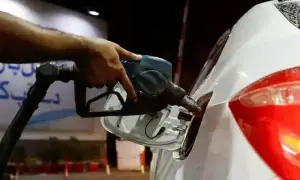
The retail prices of all major petroleum products have crossed the Rs 100 per litre historic mark as of April 1, 2012. The governmental decision is based on the rising cost of imported crude as well as imported POL products. The PPP-led coalition government has acted more prudently, responsibly and honestly than its predecessor the Musharraf-led government which dithered over passing the cost to consumers with a view to winning the 2008 general election. But then the choices for the present leadership are much more limited.
With forex reserves declining and no chance of external help, the incumbent government has indeed taken a huge electoral risk. In an election year, gasoline prices can ignite popular unrest and aggravate frustration. There is no substitute for oil. We can generate electricity - through hydel dams, natural gas, coal and renewables such as solar and wind - switching from source to source, according to the price but oil remains by far the predominant fuel for transportation.
In Pakistan, consumption of Compressed Natural Gas (CNG) has been on the rise but it is still much less than gasoline. Raising the CNG prices is a more difficult proposition for the government because the CNG filling stations are by and large owned by politicians and bureaucrats doled out as political patronage. Protest across-the-board is expected to be shrill and vehement. The government has neither too many choices nor enough opportunities. It can reduce the two taxes - GST and PL - on imported oil and domestically produced natural gas to ease the price rise. This would, however, reduce the investment funds sorely needed to develop local resources of energy. In the present weak budgetary fiscal situation this would be rather difficult. It will be required to shun its notoriously ostentatious style of governance. It will also be required to significantly curtail the budgetary haemorrhage on account of white elephant government-run business entities. The people would willingly bear the rising inflationary burden if they see the political leadership sharing with them as well.
The advantage of Opec and especially Saudi Arabia to work together and manage international price of oil by increasing production and cutting back when prices were about to fall is gone. Today major oil producers are pumping flat out. Both the Russians and the Saudis need to keep the price above $100 per barrel to power their shaky economies and meet the growing demands of their people. In the case of Russia in particular, oil price, according to Atlantic Monthly, must be $117 per barrel to help the Vladimir Putin-led government to balance its budget. In reality, however, Russian budget managers would like to see oil around $140 a barrel because Putin announced a $260 billion of spending programme during the election plus a defence programme totalling $763 billion. The Asian economic growth and forced roll back by China and India of oil imports from Iran - 20 and 16 percent respectively of their needs - has kept the price of Arabian Light at a premium of $20 per barrel above the domestic average price (WTI) in the US with no supply-side risk.
Pakistan's economy could absorb imported oil between $85 to 90 per barrel. However, the average imported price of crude, between January and March, is in the range of $118-120 per barrel and the average of blended POL imports around $108-109 per barrel. While the volume of imports has dropped by three percent the price increase is around a whopping 19 percent. Our monthly oil payments have gone up by $200 million a month ie from 1.1 billion to 1.3 billion dollars. The cost of fuel hedging depends on the predicted future price of fuel. A country or a company that does not hedge its fuel costs generally believes one, if not both of the following: (a) the country or the company has the ability to pass on any and all increases in fuel prices to their customers; and (b) it is confident that fuel prices are going to fall and is comfortable paying a higher price for fuel if, in fact, their analysis prove to be incorrect, according to a noted Houston-based energy advisory firm. In 2008-2009, a proposal to hedge 25 to 50 percent of our imports was floated but it never materialised, out of fear being caught on the wrong foot and then subsequently hauled up before the courts. It is therefore time our policymakers realised whether the country needs to develop a hedging strategy by analysing its historical and future anticipated fuel consumption volumes. They are also required to find a solution to the problem that importing our total needs on cash does not provide any breathing room and we have to pass on the full impact of the hike in landed cost of oil to the consumers.
Not long ago, the worry about fossil fuels was how fast crude oil output would dwindle. Now, new and unconventional sources of oil are filling the gap. US oil imports have fallen from a high point of 60 percent to 45 percent. A combination of new technology, alternate fuels and conservation may turn US from a net buyer to a net seller in the long-term. But China, India and other emerging economies are going to replace it with the result that plentiful and expensive crude oil will translate into painfully high prices at the pumps. Oil price at above $100 and possibly as high as $200 a barrel is definitely going to take a huge chunk of Pakistan's import bill and put added pressure on household budgets. It would also eat into economic growth, put pressure on the price line and slow down economic recovery.
One of the expected consolations of high crude prices was the assumption that it would free development of carbon-free alternatives such as wind and solar. New and unconventional sources such as Shale oil, deep beneath the ocean floor oil ie off-shore known as 'extreme oil' means oil would continue to flow and keep increasing the carbon footprint on the planet. It means oil will remain a costly pollutant. Pakistan cannot ensure cheap oil but it can embark on a course of energy efficiency and also change the energy mix. We could provide fiscal incentives to automobile assemblers to produce better mileage vehicles. After all, doubling the mileage of your vehicle is equivalent to cutting the cost of gasoline purchase to half in a month. Diversifying energy supply towards wind, solar, nuclear and bio fuels may be the only solution to this challenge. After all, human anxiety has extended the age of crude oil production. The same anxiety can find a solution on more beneficial terms.















Comments
Comments are closed for this article.