


Driven away by the violence in central Syria, Abu Alaa and his family have fled their hometown of Homs, in search of a better future in Lebanon. But Abu Alaa ('father of Alaa') is disappointed and apprehensive. "Life here is not better. I am working all day and I can barely feed my family," he told dpa.
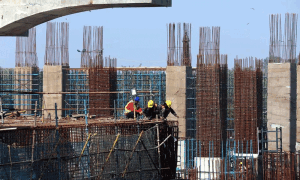
Abu Alaa - who was afraid to give his full name - and his five-member family is staying at a relative's house in Beirut. Originally a farmer, the 45-year-old is working in construction, in the eastern part of the Lebanese capital. Like many unregistered Syrian refugees in Lebanon, he complains that he does not have access to local or international aid. The United Nations High Commissioner for Refugees (UNCHR) says there are around 12,000 Syrian refugees in Lebanon.
The figure is a rough estimate, as many prefer to stay with relatives or acquaintances rather than claim refugee status, according to UNCHR officials. With no sign of an end to the year-long Syrian crisis, the Lebanese authorities are working on a plan to cope with a flood of refugees from Syria, according to local media.
Anwar, a native of the southern province of Daraa where the Syrian uprising began, says he got married two months before the revolt started last March against the rule of President Bashar al-Assad. "I had to bring my wife here to live with me. She is pregnant," he told dpa.
"Don't ask me how I am going to pay for the hospital when she gives birth to our baby. I earn only 20 dollars a day, with which we can hardly survive," he said. Lebanon's Higher Relief Council (HRC), which is supported by the government, helps cover the medical costs of emergency cases. But the agency does not provide direct daily aid for refugees.
With more Syrians taking refuge in neighbouring Lebanon, the HRC has asked the Lebanese government for an additional 2 million dollars to help the displaced. Minister of Social Affairs Minister Wael Abu Faour recently warned that the HRC would stop helping displaced Syrians if the requested money was not provided.
The UNCHR has estimated that a total of around 30,000 Syrians have fled to the neighbouring countries of Lebanon, Jordan and Turkey since the conflict erupted. According to Dana Suleiman, the UNCHR spokeswoman in Beirut, the agency's teams have been working since the outbreak of the Syrian crisis to support those Lebanese governmental and non-governmental organisations providing shelter and care for refugees.
Humanitarian organisations, barred by the Syrian authorities from entering the country's restive areas, are instead offering assistance to Syrian refugees. The International Committee of the Red Cross (ICRC) has begun helping the Lebanese medics treating injured Syrians who have been smuggled out of the country.
Jurg Montani, the ICRC head in Lebanon, has said that since the beginning of the Syrian crisis, his agency has provided refugees with food and other relief supplies, including blankets, mattresses and hygiene material. But what little aid is available cannot be accessed by the likes of Abu Alaa, who may be lucky to live with relatives but are still struggling to make ends meet. "If the situation remains like this, I will run the risk of taking my family back home. At least, there they will not starve because I am a farmer," he said.



















Comments
Comments are closed for this article.