


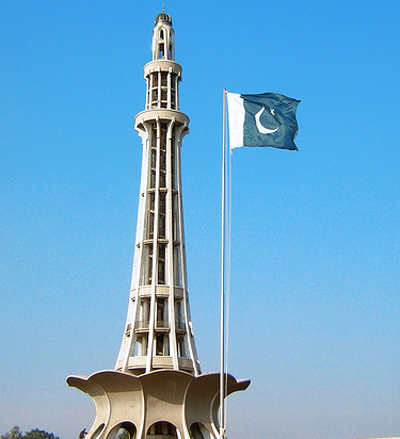
 The nation celebrates Pakistan Day today, marking the passage of the historic Lahore Resolution in 1940 that laid the ideological foundation for the creation of a separate homeland for the Muslims of the Indian Subcontinent seven years later. The new state weathered many storms, some generated by the colonial power's ill-intentioned implementation of the Partition Plan leading to wars with India, and others by the intrigues woven by the power-hungry military generals and collaborative civil bureaucracy and the pliant judiciary. If one is to identify a single factor that contributed to India's steady progress and Pakistan's constant struggle to attain stability, it has to be India's uninterrupted march along the democratic path and repeated military interventions in Pakistan's political process. Six decades after independence, democracy in Pakistan has yet to strike firm roots. It is a measure of the people's urge for freedom and progress that unlike the 30-40 years survival rate of authoritarian rulers in the Arab countries, and elsewhere in the world - even in Europe where Spain's strongman Francisco Franco ruled for more than 36 years until he died in 1975 - the longest stint for a Pakistani ruler in uniform has been 11 years. Also, every military ruler felt compelled to seek legitimacy through judicial endorsement, with the latter invoking the so-called 'Doctrine of Necessity.' That though, needless to say, did not change the reality of dictatorship and the harm it did to the nation's body politic. Thanks to the relentless struggle of the people for a better Pakistan, things are now looking up. The judiciary has atoned for its past sins by taking a strong stand against General Musharraf's military regime, and passing a historic full court judgement of July 31, 2009, that buried the 'Doctrine of Necessity', and built a barrier against any future military adventurism saying "illegal acts will always remain illegal, even if not challenged in a court, in the streets or in the political arena". There is a robust media keeping a watchful eye on the government's and the Establishment's acts of omission and commission. Unlike in the past, when the opposition leaders conspired with the Establishment to oust democratic governments, the main opposition at present is exhibiting profound political maturity. Having learnt its lessons from past experience, it is unwilling to do anything that might undermine democracy. And despite the many problems of governance and the squabbling between state institutions, the political process is moving in the right direction. For the first time in this country's chequered political history one elected government will be handing over the reigns of power to another elected government following the upcoming general elections. These developments show that Pakistan is well on its way towards realisation of the vision the framers of the Lahore Resolution had presented on this day for a separate and strong Muslim homeland. Copyright Business Recorder, 2012


















Comments
Comments are closed for this article.