


Following the sub-prime crisis three years ago, the world of mortgage financing has been relegated to something approaching the criminal underworld. A number of young and ambitious bankers suddenly found themselves without jobs, financing, homes and everything else they had almost worked hard to achieve.
Because that's the truth. Unfortunately, for many of these bankers, the sub-prime crisis was a disaster of their own making. Complex risk-distribution securities packages, virtually unintelligible to anyone outside the mortgage financing industry, were their mental offspring, and unfortunately they grew up to be neurotic, anemic and ultimately not up to the task of reducing the risk quotient associated with lending to people with a high likelihood of not being able to pay back their loans. That was the crux of the crisis - a shrinking market that required creative strategies to draw in new borrowers and buyers of property.
To expand the market, financiers attempted to woo income groups not typically associated with mortgages and more associated with Project Housing schemes; high-risk borrowers who could receive loans on relatively easy terms, but at definitely higher rates than regular borrowers with solid credit ratings. The practice of lending to people who normally wouldn't receive loans based on their patchy credit history was a relatively new development and only took off once the real estate market reached a saturation point and new housing was a flat market.
But it was the policy of financial deregulation during the first Bush administration that allowed for high-risk strategies to be presented as low risk investments and redistributed through stable blue chip investments like pension schemes and mutual funds. Baskets of securities that tied in returns on stable investments to risk on borrowers with bad credit histories endangered both and in the end, when the number of defaulters bankrupted the lenders, it was pension schemes and mutual funds that took the highest losses, wiping out the earned savings of generations of Americans and having a knock-on effect on the global economy.
The financial crisis and the sub-prime meltdown also had the further side-effect of putting mortgage financing in a bad light. The idea of mortgages never developed in Pakistan and the financial meltdown made the prospect of introducing mortgage lending a no-go in the Pakistani market. On the plus side, what this meant was that the sub-prime crisis did not affect Pakistan's economy as severely as those of Europe or the US. On the downside, financing for real estate is virtually non-existent in Pakistan and, contrary to popular belief, this isn't a good thing.
In any country, construction and real estate development usually make up a healthy segment of the GDP. In most developed countries, construction and real estate development on the back of mortgage financing usually make up the single-largest sector of the economy. Few individuals have enough savings or liquid funds to enable them to purchase property outright. In this regard, it is important to note the differences between home loans and mortgages. A mortgage is a security that a lender holds on a property until the borrower pays it back.
A home loan needs to be secured against other investments or assets. This means in order to build a house in a place where only home loans are available, one has to have existing assets or investments equivalent to the size of the loan required as collateral. Since most people don't have assets of that sort in the first place, a home loan essentially allows for people who already have assets to own more. Mortgages, on the other hand, allow for people with low disposable incomes, people who can't afford to purchase property outright, to own homes with loans that they pay off over time. This is also different to paying instalments, in that with a mortgage one can take possession of a property from the moment the mortgage is secured, rather than after completion of the payments.
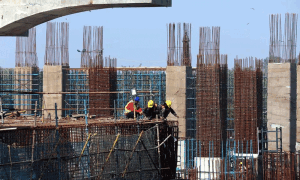
In Pakistan, the real estate and construction industry is worth around Rs 500 billion, especially in the context of the Public Sector Development Programme (PSDP) which amounts to up to Rs 400 billion, and Annual Development Programs of the provinces worth an equivalent amount. Unfortunately, the size of the industry is currently restricted, a fact that also adversely affects about 44 related industries that would gain from growth in the construction and real estate industry. The primary reason that the real estate industry is so limited is the lack of mortgage financing for people who would like to own homes, but do not have the means to purchase property outright. Hence they live in rentals or slums, which essentially re-circulate liquid cash without contributing to growth. In a mature real estate industry where mortgage financing is available, these same people can secure the means to purchase property and build their own homes. The obvious effect of this is growth in a vital sector of the economy, providing employment to people, and with associated industries like cement etc also benefiting. Obviously it would also help make up the shortfall of millions of homes that currently exist in this country.
Currently, in Lahore alone, there is a shortfall of about 2 million housing units; which means two million households that require homes. The need of the hour is to develop affordable housing, but at the same time, create the means by which people can take ownership of properties and use them as homes to live in. This is the key challenge. A project like New Lahore City, which was conceived of as a way to bridge the gap by focusing products on lower-income groups, while able to provide affordable property, cannot provide homes as the property can only change hands once the payments are complete. As such, the majority of the masses remain outside the reach of even the most modestly priced housing schemes. This is where mortgage financing can play a crucial role. We should not let the sub-prime crisis disillusion us about the benefits that well regulated mortgage financing can provide to the economy. With a well-regulated system, real estate and construction can contribute considerably more to the economy, as well as providing homes to millions of homeless people around this country.
(The writer is a partner and director with New Lahore City, a joint project of the Zaitoon Group and the Rafi Group)



















Comments
Comments are closed for this article.