


Prime Minister Yousuf Raza Gilani has taken a serious notice of unscheduled loadshedding and constituted a high-level committee to seek out-of-the-box solutions in an effort to resolve the issue. The committee is to be headed by the Minister of Finance and its members include the ministers for Water and Power and Petroleum and Natural Resources, Deputy Chairman Planning Commission and Acting Governor State Bank of Pakistan.
The members of the committee would, without doubt, lead one to conclude that the focus of the Prime Minister is to end the intractable inter-circular debt that is profoundly crippling the ability of the sector to operate at anywhere near optimum capacity, leading to massive power shortages accounting for 10 to 16 hours of loadshedding a day.
Third year running, the government has been unable to eliminate the inter-circular debt that has compromised the liquidity of the entire energy sector. Thus non-payment of energy bills by state ministries/departments/autonomous entities has led to a severe shortage of liquidity in the energy sub-sectors, resulting in the inability of Pakistan State Oil (PSO) to import the necessary input, ie oil. Directives by the President/Prime Minister to the Finance Ministry to release funds on an emergent basis to enable PSO to pay for the import of the necessary crude/refined oil have become a matter of routine.
This payment, in turn, has compounded the fiscal deficit with its fallout on inflation that, in all probability, accounts for the government's foot dragging in terms of eliminating subsidies to the power sector (budget 2011-12 envisages 123 billion rupees to Wapda/Pepco and 25 billion rupees to KESC) and slowing down the pace of power sector reforms, a factor that has fuelled not only the budget deficit but has also contributed to the stalling of the International Monetary Fund's (IMF) Stand-By Arrangement.
The consensus is that if the government focuses on eliminating the inter-circular debt, much of the woes of the populace struggling with ten to sixteen hours of daily loadshedding would evaporate overnight. That the government has not succeeded in ridding the sector of this malaise till now shows that it is easier said than done: the major stumbling block remains its inability to enforce electricity bill payment by state entities like Pakistan Steel, Pakistan International Airlines (PIA) and Pakistan Railways (PR), as well as federal/provincial ministries and departments.
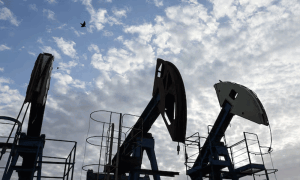
Pakistan has a total installed capacity of roughly 18,500 MW. Around two-thirds, 12,500 MW, is generated from furnace oil and natural gas, a more expensive source of energy relative to hydel, with one proviso: that they operate at full capacity. This is not possible, as is evident, due to a shortage of gas and oil, which is primarily due to the circular debt. Only around 6,500 MW of hydro-electricity is available provided the generating units work to their full potential. The hydel energy generated fluctuates seasonally based on a shortage of water in dams that may be attributable to low rainfall or high demand from the agriculture sector for irrigation purposes.
Be that as it may, the government is also considering expanding the country's existing generating capacity. One way is to install the controversial rental power projects (RPPs) that have been unable to produce at capacity due to failure of the government to deliver the critical input of furnace oil. The second way being considered by this government, as it was by its predecessors, is to install the Iran-Pakistan (IP) gas pipeline and Turkmenistan-Afghanistan-Pakistan-India (TAPI) gas pipeline. Both these projects have stalled for a variety of reasons: IP because of US opposition to the pipeline and TAPI because of the high-risk factor involved as it passes through war-torn Afghanistan. Recently Dr Hafeez Pasha insisted that there should be no delay in initiating the IP - an economically viable project. However, this may further strain Pakistan-US relations which, given that the US is committed to the 1.5 billion dollar Kerry-Lugar bill as well as reimbursement of the expenses incurred on the war on terror under the Coalition Support Fund, is simply not feasible from the perspective of the country's economy at the present moment in time.
It is therefore imperative that the government eliminate the inter-circular debt as the first step in dealing with the energy crisis. In this context, it is unfortunate that the high-level committee constituted by the Prime Minister does not include all the stakeholders, ie major defaulters namely PR, PIA and Pakistan Steel as well as Finance Secretaries of all the provinces.









Comments
Comments are closed for this article.