



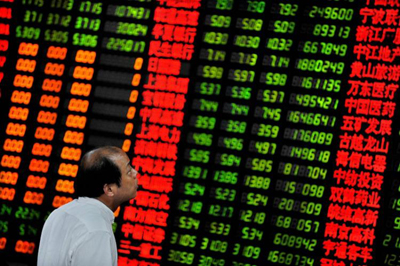
 HONG KONG: The Shanghai Composite Index slipped to the lowest level since April 2009 in thin Monday morning trade, with mainland investors jittery over a possible policy response from Beijing after data last week pointed to a serious risk of a sharp industrial slowdown.
Property stocks fell sharply after Xinhua News Agency reported that Beijing would maintain its "unswerving stance" on tightening measures for the property market in the new year, citing a Communist Party Politburo meeting chaired by President Hu Jintao.
Midday turnover in Shanghai stayed near a three-year low and is expected to stay low ahead of the central government's annual economic meeting, reported to be taking place this week, as investors look for clues of possible monetary policy easing to prop up the slowing domestic economy.
"The smart money is still not buying in either mainland or Hong Kong markets," Hong Hao, a Beijing-based global equity strategist with China International Capital Corp (CICC), told Reuters. "The government is still very reluctant to release curbs on property. While it is stuck between a rock and a hard place, Beijing runs the risk of being behind the monetary policy curve at this rate."
The Shanghai Composite Index was down 0.5 percent at 2,304.8 at midday, underperforming Asian peers. It briefly traded below 2,300, the lowest intraday level since April 2009.
Top property developers China Vanke Co Ltd and Poly Real Estate Group Co Ltd lost 4.1 and 3.8 percent, respectively. The Shanghai property sub-index was a standout underperformer among sectors, down 1.9 percent.
HONG KONG GAINS IN WEAK TURNOVER
In Hong Kong, the Hang Seng Index was up 1.42 percent at 18,850.7 by the midday trading break, as strength in Chinese issues helped the benchmark reclaim the 18,818 support level it broke below on Friday.
Gains came in midday turnover that neared a year low, suggesting market confidence remains fragile with a European deal to forge a deeper fiscal union expected to fall short of a complete solution to the euro zone debt crisis.
Underscoring difficult market conditions, Haitong Securities postponed its $1.7 billion initial public offering in Hong Kong, with sources telling Reuters that the mainland's second-largest brokerage by assets was considering relaunching in the first quarter of next year.
Chinese financial and property counters led gains, with investors betting on more policy easing by Beijing after an economic work meeting this week.
Ping An Insurance (Group) Co of China Ltd, China's second-largest insurance company, gained 3 percent. Industrial and Commercial Bank of China Ltd, the mainland's largest lender, rose 2.8 percent.
The Hang Seng Index is down more than 18 percent in the year to date, ranking among the worst performing indexes in Asia this year -- largely on the strength of a sell-off in the third quarter as investors priced in a "hard landing" in China.
But recent signs suggest that the trend has reversed, with mainland markets, which are largely closed to foreign investors, performing relatively worse than the H-share market.
While the China Enterprises Index, also known as the H-share index, is up almost 8 percent in December to date, the Shanghai Composite is down 1.2 percent.
In a note on Monday, CICC' Hong warned that investors betting on aggressive easing may be disappointed, suggesting any monetary policy loosening is going to offset the slowdown in the China economy, rather than change economic trajectory.




















Comments
Comments are closed for this article.