


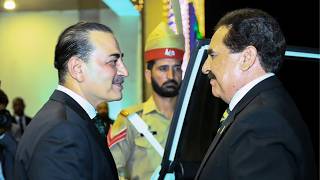
"Go east, young man" looks set to become the rallying cry of the 21st century", the latest Economist aptly pointed out this month. With 87 percent of Chinese, unlike 30 percent of Americans, thinking that their country is going in the right direction, according to the same publication, President Zardari''s frequent visits to China is a step in the right direction.
The Chinese Premier''s back to back visits to arch rivals India and Pakistan is depicting that economic ties are going to shape the politics of tomorrow. Despite the fact that Pakistan is a strategic ally of the US in the war against terror, President Obama visited India a few weeks back but not us. Even China''s top guy visited India before he came to Islamabad.
It makes perfect economic sense for this tilt as India is a much larger and stable economy than ours. But given the decades'' old political tension between India and China, the latter''s support could be more, relative to economic size, towards Pakistan. Plus, India is a potential threat to China''s regional economic supremacy.
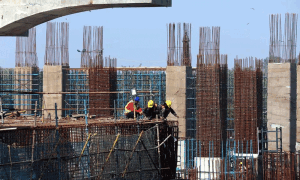
We should pounce upon the opportunity to increase economic ties with China and fill the supply gap with their help by bolstering our infrastructure, rehabilitation of PSEs through public private partnership, and garnering more trade through the development of Gwadar to name few moves.
At this juncture, Pakistan''s biggest trade partner is the US while China stands third. That does not make sense on pure economic terms as US is geographically much farther than China. On political grounds, historically, the US has been using Pakistan as ''a girlfriend for rainy days'' while Pakistan has always sought it as a legitimate husband.
What happened after Russia left Afghanistan in the 1980s could be repeated in 2010s after the US and the allied forces leave Afghanistan i.e. a halt in economic support to Pakistan.
It seems like a simple equation to focus more on China. But our political elite, as now documented by WikiLeaks, is not independent and is influenced by the West and the Middle East.
Most of our brains and labours are being exported to these countries which are sending hefty remittances back in the country, partially explaining this tilt. But political elite''s personal assets are largely in these countries and they have a natural inclination to safeguard it; whenever they are in exile, their preference of stay is the West or the Middle East. These conflicts of interest are hindering political and economic ties with the emerging regional giant, China.
Men in the khakis have to keep the conflicts with India alive to attract the major budgetary resources flowing towards them at the expense of the country''s growing educational and health needs. But that discriminatory attitude of country managers might not change for obvious reasons like they failed to raise the tax-to-GDP ratio or like they failed to implement other economic policy and implementation reforms in last decade.
In a realistic frame our leaders could do best by leveraging upon our relations with the West and China to become a transit point for western producers in China''s market. We need to market Pak-China FTA in our favour.
Multinationals are currently reluctant to directly enter the Chinese market for two reasons: a) China does not have foreign investor friendly policies, and b) they are copy cats - like what happened with Mercedes Benz.
Pakistan, on the other hand, has one of the most relaxed rules and regulation for foreign players, yet very poor spill over of technology. We need to build transportation infrastructure with China including railway lines and roads network. We need to expedite development of the Gwadar port to enhance the role of intermediation between the rest of world and China.
But for doing that we should be cognisant of the fact that our ties with China''s socialist regime in 60s, relative to rest of world, was much better than of today. In the 60s, PIA was one of the few international airlines that used to have China in its route.
In the last decade, despite Musharraf''s very friendly investment policy towards China, Chinese investment inflows in the country were limited. The reason being there are some elements working against Sino-Pak economic ties. The case in hand is repeated killings of Chinese engineers in Pakistan.
These terrorist activities could be done by India, US or anyone else. What is required at our end is to use our one of the strongest intelligence agencies to stop such incidents and ensure the safety of Chinese people like we do for the Western experts.
This will help China tap our vast mineral resources and could help stop the bleeding of our PSEs apart from us being a transit point for the Chinese market. Unless that happens, the slogan of "Sino-Pak friendship as high as Himalayas and as deep as ocean" would become as "hollow as a drum".
MONEY AGGREGATES:
The government continued with its heavy reliance on domestic banking system to fulfil its ever increasing fiscal appetite. With Rs51 billion of note printing for the week ending December 4, the year-to-date government borrowing from the central bank crossed Rs300 billion.
This is going to fuel inflation tomorrow and may entice the SBP to further raise policy rate, while the government was not shy of going to commercial banks last week as it borrowed as much as Rs31 billion in just a week time.
With no significant change in private sector borrowing or net foreign assets, the overall money supply increased by 1.1 percent or Rs64 billion for the week ending December 4. Demand and time liabilities increased by mere Rs40 billion despite hefty money creation as the currency-in-circulation increased by Rs24 billion last week.
(Feedback at [email protected])
=============================================================

KEY MONETARY AGGREGATES AS ON DEC 04

=============================================================

                                       Rs (mn)

                                   4-Dec     27-Nov    Change

=============================================================

Currency in Circulation          261,333    237,724    23,609

Total Demand & Time Deposits      65,654     25,690    39,964

Broad Money (M2)                 328,438    264,780    63,658

NFA                               75,750     68,479     7,271

NDA                              252,687    196,299    56,388

Net Government Borrowing         354,559    280,000    74,559

Borrowing for budgetary support  391,072    309,321    81,751

from SBP                         302,522    251,310    51,212

from scheduled banks              88,550     58,011    30,539

Commodity operation              (37,895)   (30,712)  (7,183)

Credit to non-govt sector         34,185     27,535     6,650

to private sector                 60,433     51,485     8,948

to PSEs                          (26,983)   (24,697)  (2,286)

-------------------------------------------------------------

Source: SBP

=============================================================








Comments
Comments are closed for this article.