



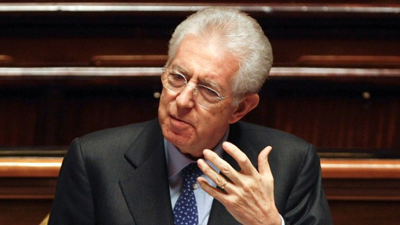
 MILAN: Italian Prime Minister Mario Monti shored up support for a plan of budget cuts and pension reforms due to be unveiled on Monday in a bid to defeat a crisis that has threatened to destroy the eurozone.
The measures are aimed at calming a wave of panic on the market that helped oust Monti's predecessor Silvio Berlusconi and pushed borrowing costs as high as 8.0 percent, raising fears that Italy could slide into bankruptcy.
European leaders have raced to emphasise their support for Monti and most of Italy's main political parties have also given him backing but trade unions are already up in arms over a series of proposed changes to pensions.
Monti, a former European Union commissioner and economics professor, warned Italians when he came to power last month that they faced "sacrifices" but said he would also strive for "equity" -- Monday will test that balancing act.
The reforms have not been officially announced yet but are believed to include a tax on large capitals as well as pension reforms -- with the aim of balancing out the pain they will cause to left- and right-wingers alike.
"When a doctor arrives, it's rare that the medicine prescribed is good. More often than not, it's a bitter medicine. Especially when a sick man has to be saved," said Pier Ferdinando Casini, leader of the centrist UDC party.
After meeting with Monti on Saturday, Angelino Alfano, the head of Berlusconi's People of Freedom party, said: "Our main advice is to proceed with equity (so that) the burden be in line with what taxpayers can afford."
"Monti has been called in precisely to take decisions which are far from easy," Alfano said. But Susanna Camusso, head of Italy's largest trade union, CGIL, said she would oppose the measures "we consider to be wrong."
The measures are set to be adopted by the cabinet on Monday and will then go before parliament for expected final approval before the Christmas recess.
Italy is under intense pressure to move quickly as it faces a tough timetable to refinance 400 billion euros in debt next year and any insolvency problem could trigger a wider collapse in the 17-nation eurozone.
Italy's public debt is equivalent to around 120 percent of gross domestic product (GDP) and economic growth has been anaemically low for years.
The economy has also been weighed down for decades by bureaucratic obstacles that the international community has long pressured Italy to remove.
Despite the problems in the eurozone's third largest economy, Monti and the International Monetary Fund have firmly denied insistent rumours that Italy is preparing to accept a credit line from the IMF to get over the hump.
The IMF and the EU are however keeping Italy under special surveillance, sending teams of auditors to ensure it maintains its reform promises.
Monti has stressed he will ask Italians to tighten their belts yet again -- after two austerity packages already passed in Italy this year.
His aim is to balance the government's budget by 2013.
An increase in housing tax, a small tax on large capital and a rise in value-added tax (VAT) are all on the table in a package worth 20 billion euros ($26.8 billion), according to recent reports in Italian newspapers.
The most delicate topic for Monti is pension reforms, which the government has promised to accelerate with an "incisive" package of changes.
The first indications are that the government plans to raise the number of years employees will be required to pay dues before they can retire with a full pension from the current 40 years to 41 or even 43 years.
The government also wants to calculate pensions based on wage levels over a retiree's entire career rather than only the most recent pay-checks, as well as bring forward the planned date for an increase in women's pension age.
Economic Development Minister Corrado Passera, a former senior bank chief, warned last week that Italy risked slipping back into recession and the plan is also expected to emphasise measures to boost economic growth.
The measures will give Monti an extra boost ahead of a summit of European Union leaders in Brussels on Thursday in which the outline of a deeper economic integration in the eurozone is expected to be sketched out.




















Comments
Comments are closed for this article.