


JS Global Capital Limited - Analysis of Financial Statements Financial Year 2008 - Financial Year 2009
JS Global Capital Limited (formerly JS Capital Markets Ltd), with a long-term rating of AA by PACRA, is a subsidiary of Jahangir Siddiqui and Company Limited. The company started its operations in September 2003.
The principal activities of the company are share brokerage, money market and foreign exchange brokerage, equity research, advisory and consultancy services. It is a publicly listed company which trades on the Karachi Stock Exchange and one of the top three equity brokers in Pakistan.
JSGCL provides financial and advisory services to its parent group, JS Group. In 2006, Global Investment House K.S.C.C., a leading Kuwait-based regional investment bank in the Middle East invested 37 million dollars in JS Capital Markets through an acquisition of 42.8 percent equity stake. As a result, the company was renamed as JS Global Capital Limited and its equity was raised to 47 million dollars. JS Global Capital has a capital adequacy of 762 million dollars, which is the highest in the country for a stock brokerage, business financing and advisory services company.
JS Global Capital Ltd has recently finalized an agreement with Mubasher of Dubai to introduce the next generation of online trading system in Pakistan. The Mubasher system will offer a fast, secure and simple online service to investors due to its foreign design and operation under the FIX protocol. The inclusion of the Dubai and Abu Dhabi markets would make the JS Global platform the first multi-exchange online environment in Pakistan offering the largest range of market options to investors.
CAPITAL MARKET'S RECENT PERFORMANCE
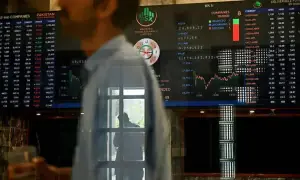
Pakistan's capital markets have been going through difficult times since last year. Presently, volatile situation within the market is conducive for trading only, rather than raising capital for the industry. The market floor, which was imposed on August 28th, 2008, was lifted on 15th December 2008 without the resolution of CFS Mark-II issues. As a result, after the removal of floor, several stakeholders resorted to litigation to solve their unresolved issues pertaining to CFS Mark-II, as these parties were not taken into confidence in the resolution of their mutual disputes.
The floor itself proved harmful and led to many operational, structural and risk management issues with the market. The imposition of floor for about four months resulted in a virtual halt of the stock market and shattered the investor's confidence. In the bigger perspective, global economic meltdown and internal security environment has increased investor's anxiety and affected the performance of Pakistan's equity markets. Market fell by 36 percent in 12 trading sessions after the lifting of floor.
The much-awaited decision regarding accounting treatment of impairment value of 'available-for-sale' equities was announced last month. Eventually, relaxation was given in implementation of International Accounting Standard 39 (IAS 39) and as a result, these would be shown on the 'equity' side of the balance sheets. The decision has brought an end to all ambiguities about the impairment of investment values, still the analysts call the decision as 'out-of-the-way method' to support ailing market and again proves the inability of Pakistan's corporate sector to absorb shocks.
FY08 has been a brutal year for the global stock markets. Equity markets in Pakistan also faced difficult situations; share prices plunged a massive 58 percent and market capitalization in the second half declined by 52 percent. Due to global financial meltdown, prices of almost all asset classes are going down and the world is going deep down into economic recession. This collapse, initially thought to be confined to the US home mortgage sector, actually had the domino effect and resulted into full-blown global credit crises.
RECENT PERFORMANCE
Despite the slowdown in the economic activity JSGCL has been able to upbeat its competitors by using their efficient risk management strategies and brokerage, which has resulted in the annual results of the company. The company has posted a Rs 206 million of earnings, which has higher compared to its competitors.
We can see that there has been a severe downfall of the operating revenue, this is resulted because of low volume traded in the equity market, low investment opportunities for the investors etc. However JSGCL has able to post favorable revenue because of the increase in the market share of the equity brokerage department and an excellent performance in the fixed income and the Foreign Exchange Trading Department.
===========================================================

                                      2008-09       2007-08

===========================================================

                                           Rupees

===========================================================

Operating revenue                 316,377,931   886,845,595

Profit before tax                 273,152,774   740,113,870

Profit after tax                  206,239,993   624,134,125

Earning per share - (Restated)           4.12         12.48

===========================================================
FINANCIAL PERFORMANCE (FY04-FY09)
The overall profitability of JSGCL declined in FY09, this was because of the low economic activity seen in the share market as well as in equity and capital market. The brokerage and investment banks' profitability was severely affected as a result. Huge decline was observed. First the Operating Revenue which decreased by 66.9% in FY09. The profit after tax declined from Rs 740 million in FY08 to Rs 273 million in FY09. The basic reason was due to low revenues for the period of FY09.
Hence a decline was witnessed in PBT/revenue ratio as well as in PAT/revenue. For PBT/revenue it decreased from 55.11% in FY08 to 44.91% in FY09 and for PAT/revenue it decreased from 65.35% to 59.48% in FY09. Considering the PAT alone, we can see a decline of about 67%, even though the administrative expenses marginally decreased however it didn't impact enough to improve the profitability of the firm. Moving to ROA and ROE, the same trend can be witnessed. ROA nearly halved in FY09 reaching to just 5.57% in FY09. Whereas ROE showed a bigger decline to fall to 6.95% in FY09 from 19.02% in FY08.
Considering the industry average for both ROA and ROE, the industry average has been quite lower compared to JSGCL. The industry average tends to be in negative figures however JSGCL has managed to keep in positive figures with some nominal percentage return. This shows the leading market performance, which is portrayed by JSGCL in terms of profitability. The liquidity position has dramatically improved for the past year of FY09. There has been a huge increase of the current ratio from 2.33x in FY08 to 8.90x in FY09. There are couple of reasons for this huge increase in the current ratio.
First, there has been a considerable increase in their cash and bank balances, which has increased by 300%. Secondly, there has been a rise in short-term investments as well, which mounted to Rs 1095 million in FY09. Moreover, on the base side, there has been a decrease in current liabilities' section where the provision for taxation has been reduced to Rs 76 million from Rs 115 million. Some might argue that such high current ratio would be needed in the case of current economic turmoil and future catastrophes, however such assets tight up can bring huge opportunity cost too.
In the end, JSGCL might want to safeguard itself from future problems, which might necessitate higher liquidity. Coming to the industry average, it is quite low compared to the JSGCL's current ratio. The industry average for FY09 is .97x, this shows that the company is being performing relatively well with surplus funds to not only fulfil their liquidity issues but also to invest in short-term and gain return out of it. The debt management ratios showed a significant performance in FY09.
The company has maintained a nil gearing ratio for the current year. The debt that had been outstanding for the company has been repaired; however incurred certain amount of the financial charges on other liabilities. D/E and D/A became zero for FY09. The times interest ratio has greatly increased from 10.42x in FY08 to 24.50 in FY09. This is due to decrease in the financial charges in the current year. It has decreased by 86% in FY09 and EBIT increased by 50.5% to Rs 478.5 million in 2007 to Rs 317.8 million in 2006. Lower financial charges are mainly due to lower mark-ups on running finance.
The earnings/share saw a major decline in FY09. EPS decreased from Rs 12.18 in FY08 to Rs 4.12 in FY09. The basic reasoning behind this is the decline in the revenue for the FY09. The trickle down effect resulted in the lower profits for the current year, which greatly reduced the EPS for the current year. And also because of the number of the shares outstanding increased from 3,571,450 to 50,000,000 in FY09. Similarly, JSGCL's book value per share showed significant decline in the period under study. Book value declined from Rs 91.9 in FY08 to Rs 65.48 in FY09. This is because of the increase in the shares outstanding, however, not a proportionate increase in the equity section.
FUTURE OUTLOOK
Capital markets have been affected in the recent years because of the economic slowdown. However, government policies are likely to enhance investment opportunities. These could be ease of monetary policy, reducing interest rate and a higher tax collection from government might lead to positive approach for investors. Adding to this, starting of future markets and Debt markets operations will give more opportunities for the company to exercise. Plus more support to the brokerage firms by reintroducing margin financing which will make the brokerage firms less exposed to the risk default.
Moreover, the new product varieties offered by the company such as Online Equity Trading, brokerage services that would give more customer value and even shareholder value. Such opportunities have given JSGCL to perform better in the coming years and earn more profitable. Another positive factor for the company is the foreign exchange trading market, as we can see that the global economy is on the rise, the company can exercise its operations in the international market and off-set the downturn that is affected in Pakistan economy.
However the current condition, with low exports and political instability and foreign investors pulling out the money from the stock market. This will cause a detrimental affect to the performance of the industry. Furthermore, the recent rise in Dubai Debt fear has led to more vulnerability to the equity capital market and even foreign markets to invest upon. The investors would be unwilling to take up new ventures and resort less to the investment and look for more secured investment opportunities such as Fixed Income Securities. JSGCL has somewhat on the rise from a recent downturn in the share market. The share prices have started to rise based on the performance of the company for the current year.
=================================================================================================================

BALANCE SHEET                                    2005           2006           2007           2008           2009

=================================================================================================================

SHARE CAPITAL AND RESERVES

Issued, subscribed and paid up capital    100,000,000    138,000,000    238,097,000    357,145,500    500,000,000

Share Premium                              32,000,000              -  2,072,007,900  1,952,959,400  1,810,104,900

Unappropriated profit                     127,306,180    385,514,334    788,332,175    995,796,550  1,023,463,793

Unrealized loss on remeasurement

 of securities at fair value              (17,373,300)    (3,474,660)             -    (23,686,148)   -34,416,500

Total Shareholder's Equity                241,932,880    520,039,674  3,098,437,075  3,282,215,302  3,299,152,193

NON CURRENT LIABILITIES:

Advance against issue of shares                     -    300,499,400              -              -              -

Deferred taxation                             597,452        791,803      1,567,285      1,440,366              -

Total Non Current liabilities                 597,452    301,291,203      1,567,285      1,440,366              -

CURRENT LIABILITIES:

Running finance under

 mark-up agreements-secured               256,408,309    176,890,535    246,473,078              -              -

Creditors, accrued expenses

 and other liabilities                    519,413,760  1,197,779,507  2,001,664,608  2,264,113,388    328,816,078

Interest and mark-up accrued                        -              -        540,717     15,067,150              -

Provision against taxation                 44,108,943     42,755,104     69,667,638    115,138,087     76,601,451

Total Current liabilities                 819,931,012  1,417,425,146  2,317,805,324  2,394,318,625    405,417,529

Total Liabilities                         820,528,464  1,718,716,349  2,319,372,609  2,395,758,991    405,417,529

Total Liabilities and

 Shareholder's Equity                   1,062,461,344  2,238,756,023  5,417,809,684  5,677,974,293  3,704,569,722

NON-CURRENT ASSETS:

Property, plant and equipment              20,158,989     26,153,242     68,076,487     72,321,711     57,128,927

Intangible assets                          24,866,667     22,933,335     22,000,001     21,573,291     21,036,651

Long term loans, advances and deposits      5,879,057      1,925,305      2,685,116      4,527,628      3,892,294

Long term investment

 - advance against equity                   3,071,667              -              -              -              -

CURRENT ASSETS:

Short term investments                     52,119,900     66,018,540  1,038,133,637    708,110,076  1,095,008,267

Trade debts - unsecured,

 considered goods                         477,033,287  1,087,641,912  1,914,577,787  1,982,717,833  1,542,861,489

Loans, advances, prepayments,

 and other receivables                     10,156,482     11,659,082    613,160,050  2,003,902,349      9,496,548

Advance tax                                43,741,784     40,818,648     79,169,928    146,712,990     68,395,460

Receivable under reverse

 repurchase/CFS transaction               423,610,751    664,420,075  1,573,890,024    530,106,289              -

Cash and bank balances                      1,822,760    317,185,884    106,116,654    208,002,126    814,149,824

Total current assets                    1,008,484,964  2,187,744,141  5,325,048,080  5,579,551,663  3,608,356,633

Total Assets                            1,062,461,344  2,238,756,023  5,417,809,684  5,677,974,293  3,704,569,722

=================================================================================================================

PROFIT AND LOSS ACCOUNT                          2005           2006           2007           2008           2009

=================================================================================================================

Operating revenue                         206,322,207    424,300,760    491,477,344    886,845,595    316,377,931

Income from reverse

 repurchase/CFS transactions               45,978,693     71,453,095    186,718,842    157,055,883     45,207,460

Capital gain on sale of investments                 -              -     56,380,753     92,281,828     89,519,070

loss on revaluation of

 investments carried at fair value                  -              -      (172,671)    (3,673,229)      8,138,612

Administrative and operating expenses    (122,584,522)  (190,204,308)  (305,771,927)  (458,544,709) (342,189,640)

other operating income                        630,668     12,278,845     49,892,512    126,020,117    224,289,123

financial charges                          (9,317,703)   (12,827,662)   (11,890,235)   (59,871,615)     8,148,508

Profit before taxation                    121,029,343    305,000,730    466,634,618    740,113,870    273,152,774

taxation - current                        (18,335,593)   (42,755,104)   (69,667,638)  (115,138,087)    76,601,451

-prior                                              -      2,156,879      6,626,343      (968,577)      5,906,913

-deferred                                    (394,235)      (194,351)      (775,482)       126,919     15,595,583

Profit after taxation                     102,299,515    264,208,154    402,817,841    624,134,125    206,239,993

Basic/Diluted Earnings per Share                10.58          19.15          19.02          12.48           4.12

FINANCIAL RATIOS                                 2005           2006           2007           2008           2009

EARNING RATIOS

ROA                                              9.63%         11.80%          7.44%         10.99%         5.57%

ROE                                             42.28%         50.81%         13.00%         19.02%         6.25%

PAT/Revenues                                    40.55%         53.29%         54.85%         55.11%        44.91%

PBT/Revenues                                    47.97%         61.52%         63.54%         65.35%        59.48%

LIQUIDITY RATIOS

Current Ratio                                    1.23           1.54           2.30           2.33           8.90

Revenue/Expenses                                 1.91           2.44           2.31           2.18           3.18

DEBT MANAGEMENT RATIOS

Debt to Equity                                   3.39           3.30           2.83           2.86           0.00

Debt to Assets                                   0.77           0.77           0.43           0.42              0

Interest coverage ratio                         10.98           20.6          33.88          10.42           24.5

MARKET RATIOS

Earnings/Share                                  10.58          19.15          19.02          17.48           4.12

Book value/Share                                24.19          37.68         130.13           91.9           65.9

=================================================================================================================
COURTESY: Economics and Finance Department, Institute of Business Administration, Karachi, prepared this analytical report for Business Recorder.
DISCLAIMER: No reliance should be placed on the [above information] by any one for making any financial, investment and business decision. The [above information] is general in nature and has not been prepared for any specific decision making process. [The newspaper] has not independently verified all of the [above information] and has relied on sources that have been deemed reliable in the past. Accordingly, the newspaper or any its staff or sources of information do not bear any liability or responsibility of any consequences for decisions or actions based on the [above information].





















Comments
Comments are closed for this article.