



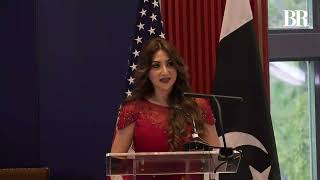
 KARACHI: Adviser to the Prime Minister on Foreign Affairs Sartaj Aziz Saturday said that a strong and economically developed Pakistan is "an approaching reality" due to strong counter-terrorism measures, internal reforms, active pursuit of energy and infrastructure projects and prudent economic policies pursued by the present government.
Speaking on the topic of "Pakistan's Foreign Policy: Challenges and Opportunities" at The Pakistan Institute of International Affairs (PIIA) here, he said that all foreign policy initiatives require a stable and supportive domestic environment and across the board political consensus.
"I hope that will be forthcoming in the wider national interest," he added.
He said that the epicenter of economic development fast moving to Asia, and it is widely predicted that the 21st century belongs to Asia.
The Adviser said parallel to these global trends, Pakistan's regional landscape remains complicated. "On one hand, the phenomenal rise of China and its close relations with Pakistan, combined with our improved ties with Russia have opened the prospects that finally, Pakistan geo-strategic location can be converted from a liability into an asset for economic development of the country.
"On the other hand, this positivity is counter-balanced by India's continuing policy to pressurize Pakistan, by sponsoring terrorism inside Pakistan to foment separatism or by ceasefire violations on the LoC (Line of Control) in Jammu and Kashmir to constrain Pakistan Army's ability to deploy more resources on the western borders with Afghanistan.'
Sartaj Aziz said further complicating regional situation is uncertainty in Afghanistan. "Since the reduction of ISAF forces, fighting has spread in different parts of Afghanistan and the casualties suffered by Afghan security forces are much higher.
These security challenges are compounded by political differences and economic difficulties," he added.
Sartaj Aziz said that the most important achievement of the past three years has been a major upgrade in Pakistan's relation with China.
"The flagship connectivity project with China is CPEC to optimize our economic and trade potential," he added. He further said CPEC is also a catalyst for regional economic integration.
"It will foster regional harmony and forge closer relations among China, Pakistan and our neighbours," he added.
Besides CPEC, he said, Pakistan is also actively pursuing various other regional connectivity projects like TAPI, CASA 1000, IP, and Torkham-Jalalabad-Kabul motorway to take further advantage of Pakistan's geostrategic and geo-economic disposition at the crossroads of three regions.
"Pakistan has also been able to improve relations with Russia and is then able to take full advantage of the new geo strategic landscape in which the centre of economic activity is shifting to Asia," he added.
The adviser said Pakistan is also committed to the SAARC process. "We regret the postponement of SAARC Summit in Islamabad and hope that this important regional organisation will not be held hostage by one country to suit its own parochial agenda," he added.
Sartaj Aziz said, "We are strengthening our relation beyond our neigbourhood, focusing on the Muslim World, East Asia and Europe. We seek to deepen cooperation in areas of security, counterterrorism, promoting economic and trade relations and seeking investment, which is essential for our economic growth.
"We are also utilising United Nations and other multilateral organisations to promote our interests in areas of peace and security, sustainable development, climate change, energy and food security.
"In the past two years, we have achieved remarkable success in countering terrorism at a time when the world is still deeply worried about this menace. Operation Zarb-e-Azb was started in June 2014 and National Action Plan launched in January 2015 are receiving worldwide appreciation.
"The heroic efforts and sacrifices of our armed forces in Zarb-e-Azb supplemented by intelligence based operations around all major urban centres, Madrassah reforms and conviction of terrorists through military courts, have weakened terrorists and extremists.
"The resultant improvement in the security situation, specially in Karachi, has brightened the investment climate.
As the energy shortages are overcome, specially for the industrial sector, the growth of the economy has also recovered from a low of 3 percent in the period 2006 to 2012 to about 5 percent with good prospects of higher growth in the coming years.
"The performance of Pakistan's equity markets and also in geo-politics has been widely acknowledged by major rating agencies and global media leaders like Forbs and Spectator.
"This turn around in the Pakistan economy can become a key positive factor in further strengthening Pakistan relations with the Middle East and Africa in the coming years."














Comments
Comments are closed for this article.