



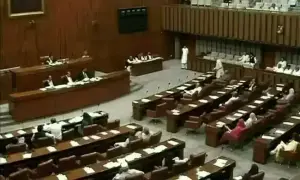
 ISLAMABAD: Senate Standing Committee on Law, Justice and Human rights on Wednesday deferred two bills including the quota for women judges in lower courts of Islamabad and also discussed the measures and mechanism to avoid violation of building code.
The meeting held under the Chairmanship of Senator Javed Abbasi discussed the Civil Courts (Amendment) Bill 2016 moved by Senator Azam Swati and the Civil Courts (Amendment) Bill, 2016, as passed by National Assembly.
During discussion on the amendment bill by Senator Azam Swati, which asked for a quota for women judges in lower courts of the Islamabad Capital Territory, the Secretary ministry of law division told the meeting that out of the total 76 judges in lower courts, 14 judges were female, 35 were male judges while 27 posts were vacant.
This percentage was quite sufficient and the ministry was of the opinion that merit should prevail and quota not be applied, he said adding same view was given by representatives of different bar councils.
Senator Saeed Ghani, however, endorsed the bill and said this quota at the lower level would help women judges come in mainstream. Senator Jehanzeb Jamaldini said some areas of Pakistan had poor education facilities and there should be quota for those.
"If we give best possible provisions across Pakistan, we can ask for merit to prevail, but if we are not even giving reasonable provisions, quota should be allowed," he added. The bill was deferred till next meeting to hear the mover of the bill.
Regarding the civil courts (amendment) bill passed by the national assembly, the committee members agreed that trials should start from the civil courts instead of high court.
However, there was disagreement on the forum for appeal after the civil courts; the district court or directly the high court. The bill was also deferred till the next meeting.
The committee also heard Chairman Pakistan Engineering Council (PEC) on implementation of building codes with special provisions for seismic protection, suggesting penal provisions and mechanism regarding violations.
He told the committee that the council had prepared a detailed document which talked about standardizing authority for construction material, monitoring on architectural and structural design, implementation authorities at federal and provincial level, rating of implementation status and the role of CDA, PSQCA, NHA, PHA, PWD and other stakeholders.
The document was endorsed by the committee, ministry as well as all stakeholders.
PEC would now draft a bill which would be sent to law division for vetting by Ministry of Science and Technology. After vetting, the bill would seek cabinet's approval and would subsequently be moved in either house of the Parliament by the ministry.
Matters relating to Pakistan Bureau of Statistics (PBS) referred to the committee by Chairman Senate were also discussed in the meeting. Secretary Statistics Tahir Pasha and Chief Statistician Asif Bajwa told the committee that all provinces were duly represented in the governing council of PBS. It was also stated that the body was autonomous in its functioning and financial autonomy was not sought.
The law division's additional draftsman explaining the status of autonomous bodies also explained that the statutory bodies related to revenue were not financially autonomous. The committee members agreed that this matter of autonomy and provincial representation needs to be debated extensively. The matter would be taken up again in next meeting.

















Comments
Comments are closed for this article.