



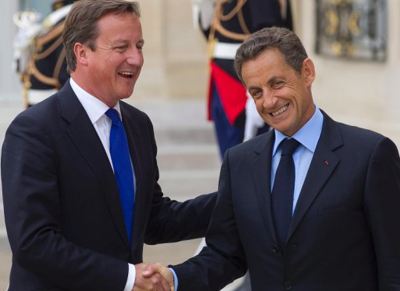
 LONDON: French President Nicolas Sarkozy and British Prime Minister David Cameron won praise from pundits and diplomats on Friday for leading international efforts to support Libya's uprising, a welcome fillip for both men in troubled economic times.
The killing of former Libyan leader Muammar Qadhafi on Thursday put the seal on a campaign which Sarkozy and Cameron have backed since Qadhafi's forces were at the gates of rebel-held Benghazi in March.
The two leaders are at contrasting points in their electoral cycles Sarkozy facing a presidential vote next year and suffering from dismal ratings, while Cameron does not have to go to the polls until 2015.
Their countries gave communications and logistical support to the anti-Qadhafi forces and spearheaded efforts to set up a NATO air and sea campaign to protect civilians and weaken Qadhafi's forces during the uprising.
The resolution of the Libya crisis, with no Western troops on the ground and no Western deaths, will help to burnish their images as heavyweight statesmen.
However, the overwhelming sense in London and Paris may be one of relief that the two countries have avoided getting bogged down in a long and expensive campaign when Europe's economy is mired in crisis.
Sarkozy's supporters, and even some who do not back him politically, said he deserved kudos for his role in resolving the crisis after a military campaign in which alliances were struck with Arab nations such as Qatar and the United States played a lower profile role.
"Nicolas Sarkozy is the man who carried all this with determination and tenacity with a certain amount of courage, because he was relatively alone in driving this war for the last six months," said philosopher Bernard-Henry Levy on.
"He did that and whatever you may think, it's written in his record and will remain so throughout history," added Levy, who put Sarkozy in touch with anti-Qadhafi forces, even though he supports the opposition French Socialists and has frequently said he, would never vote for Sarkozy.
NO "FALKLANDS FACTOR"
Richard Dalton, a former British ambassador in Libya, said the two leaders had held their nerve at the start of the campaign when it looked as if Libya could end up partitioned.
"When they faced that period of slow progress in April to July, they said, we've laid down the limits of our engagement and we're sticking to them," said Dalton, an associate fellow of London's Chatham House think-tank.
Joyful Libyans mobbed Cameron and Sarkozy when they visited Libya last month after the end of Gaddafi's four decades of rule.
Dalton said that Cameron had been careful not to indulge in triumphal, noting that he took time in Thursday's brief statement to remember the British victims of terrorist acts blamed on Gaddafi.
"Cameron has judged his recent pronouncement just right. He has not said too much, but he said things crisply."
British Prime Minister Margaret Thatcher transformed poor poll ratings with a military victory over Argentina in the Falklands Islands in 1982, sweeping back to power in a landslide the following year.
Analysts said Libya was not a "game changer" in domestic politics, but that the success would help reinforce Cameron's credibility when he has to cope with a stagnant economy and unrest within his own party over Europe.
"It was a high-risk move but has paid off remarkably well," said Andrew Hawkins of pollster ComRes.
"As a foreign policy adventure, Cameron will come out looking more statesmanlike," he added, noting that Cameron already outshone opposition Labour leader Ed Miliband in this area.
Cameron will be relieved to have avoided the kind of long-haul military campaigns in Iraq and Afghanistan, where Britain still has around 10,000 troops fighting Taliban militants.
Francois Miquet-Marty, head of political studies at LH2, said the death of Gaddafi would not transform Sarkozy's fortunes.
"In the end the most important thing for the French at the moment is the economic and social context," he said.


















Comments
Comments are closed for this article.