



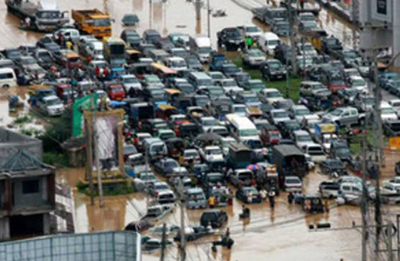
 BANGKOK: Thai officials reported progress in diverting floodwater round Bangkok into the sea on Friday but some people in the capital were still warned to move to higher floors as the government struggled with the worst flooding in 50 years.
After trying to hold the line for a week, the government decided to open some canals on Thursday to allow water to run through the inner city, which carries the risk of inundating some districts but relieves the pressure on dikes.
The government's flood crisis centre said people in parts of Don Muang and Laksi districts, in northern Bangkok, should move belongings to higher floors. The crisis centre is itself located in the old city airport in Don Muang.
Prime Minister Yingluck Shinawatra has come under fire for her management of the crisis, which was building even before she took office in early August and looks set to cost industry more than $3 billion and will hit economic growth.
Soldiers have played an active role in shoring up dikes and helping people relocate and, with Bangkok in danger, Yingluck has put an additional 50,000 armed forces personnel and 30,000 police on standby to help in relief work.
But she is resisting calls to invoke a state of emergency, which would mean deploying the army on the streets.
"It would ruin investors' confidence, which is quite weak already," Yingluck told reporters at the crisis centre.
"At this moment we can see that we (the government and the people) are cooperating very well to help us get through the problem. If I declare a state of emergency, I would be telling the world that we can't help each other."
The government's effort to guide the water around the east and west of the capital has had some success. "This mission was intended to divert water out of Rapipat Canal and it has succeeded in pushing out water to the open sea faster," the crisis centre said in a statement.
But water now covers a third of Thailand's provinces, some 4 million acres (1.6 million hectares) in the north, northeast and centre of the country.
The flooding has killed at least 342 people since July and has devastated industrialised areas to the north of Bangkok.
A seventh big industrial estate was overwhelmed late on Thursday when flood barriers at the Bang Kadi park in Pathum Thani province about 50 km (30 miles) north of the capital were breached.
The sun was shining over the capital on Friday after some heavy rain the previous evening. The weather was expected to be generally clear over the weekend.
ECONOMIC TOLL
The central bank put the damage to industry at more than 100 billion baht ($3.3 billion) on Thursday.
Governor Prasarn Trairatvorakul said economic growth this year could be closer to 3 percent than the 4.1 percent the Bank of Thailand had forecast. Finance Minister Thirachai Phuvanatnaranubala said growth might be barely 2 percent.
Japan's Sony Corp said it would delay the launch of several new cameras due in November after floods forced a halt in production at some of its Thai plants.
Thailand is a big regional hub for the world's car makers and most are suffering disruption, either because their plants are flooded or, more often, because parts makers have had to close and the supply chain has been disrupted.
The output of Japanese car makers has fallen by about 6,000 units a day because of the flooding. Germany's Daimler AG said late on Thursday it had halted car production because of the threat of flooding.
Thailand is the world's top rice exporter. Traders and analysts said as much as 3.5 million tonnes of paddy, equivalent to 2 million tonnes of milled rice, may have been damaged and loading of 100,000 tonnes may have been delayed.





















Comments
Comments are closed for this article.