



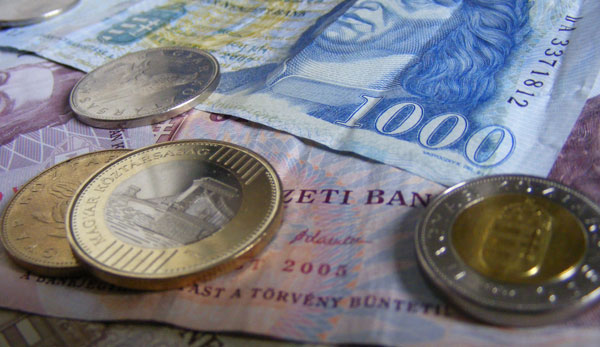
 BUDAPEST/BUCHAREST: The forint fell against the euro on Wednesday after the National Bank of Hungary (NBH) flagged the possibility of rate cuts, a sign that Europe's "currency war" may intensify ahead of the European Central Bank's March 10 meeting.
Deputy Governor Marton Nagy did not rule out that the bank may lower its 0.1 percent overnight deposit rate -- which is not its main interest rate -- into the negative and confirmed that the bank may also use unconventional policy easing tools.
"All this supports a lower FRA (forward rate agreements) curve, flatter and lower IRS (interest rate swap) and bond curves, and weaker HUF (forint)," Nomura analyst Peter Attard Montalto said in a note.
Central banks across Europe are trying to prevent their currencies from appreciating in a climate dominated by monetary policy easing.
Nagy's remarks made NBH the second central bank in Central Europe to consider negative interest rates, as signs of likely further ECB monetary easing in March and fading expectations for more Federal Reserve rate hikes put pressure on European rate setters to ease monetary policy.
Earlier this month, the Czech central bank seriously discussed negative rates and Serbia became the first in the region to cut rates since the Fed's December rate hike. Outside the region, Sweden has cut rates deeper into negative territory.
The Czech comments failed to weaken the crown, which continues to trade at the central bank's cap, levels near 27 against the euro.
The forint fell 0.9 percent against the euro on the rate cut comments to 310.31 by 1341 GMT, drifting off the 9-month highs hit on Monday at 306.85.
The forint weakened partly because investors were reversing earlier zloty selling against the currency.
Hungarian government bond yields fell by about 7 basis points along the curve, giving up part of their early gains, with 10-year papers trading at 3.22 percent.
"Always the same happens: whenever the forint starts to strengthen, the central bank will say something to knock it down," one Budapest-based currency dealer said.
But the bank needs to take action, not just talk, if it wants to prevent forint gains, the dealer added.
The region's healthy growth and trade accounts and relatively high debt yields buoy its currencies and the forint gets additional support from expectations that credit rating agencies will upgrade Hungary back into investment grade. Moody's will review Hungary's rating on March 4.
Poland's Monetary Policy Council, packed with new appointees by the pro-growth government, will meet one day after the ECB.
Forward rate agreements price in roughly one 25 basis point rate cut within next 6-12 months , even though so far none of the new rate setters clearly indicated they wanted lower rates.
"Central banks are in the easing mode now and rates in Poland are staying unchanged, which makes the zloty an attractive opportunity," one Warsaw-based currency dealer said.
While regional currencies and equities mostly eased, the zloty, which has fully recovered from a plunge to 4-year lows after Standard and Poor's downgraded Poland last month, firmed 0.2 percent to 4.367 against the euro.
The Romanian leu eased 0.1 percent, after central bank Governor Mugur Isarescu told Reuters that monetary tightening could come earlier than expected, although he said "we do not want to boost the leu currency through our measures".
Romania is a regional outlier in Central Europe, where central bankers tend to be dovish, but strong wage hikes ahead of elections there later this year are predicted to drive up inflation.




















Comments
Comments are closed for this article.