



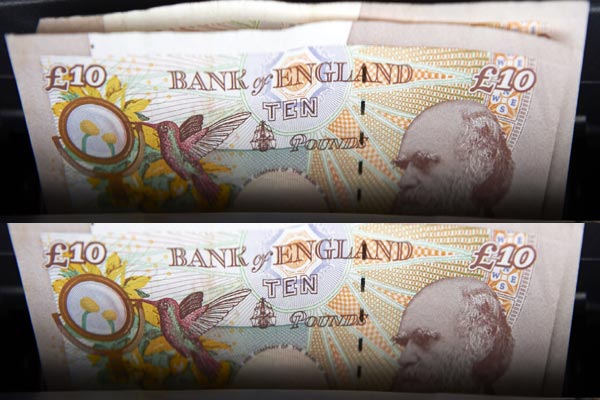
 LONDON: Sterling fell to a 7-week low against a resurgent euro on Monday, signs the government may not get its way in talks with European partners before next year's vote on leaving the EU adding to political nerves going into 2016.
Bank of England Deputy Governor Minouche Shafik also sounded to analysts to be in no great hurry to raise interest rates in a speech in London that banged home the message from last week's policy meeting of no change soon.
That offered the pound no support in a month which has seen a number of banks predict the debate over a European Union "Brexit" will make it one of the losers among major currencies in the months ahead.
"The newsflow over the weekend was not encouraging on the Brexit front," said Steve Barrow, head of G10 currency research with Standard Bank in London.
"That's one reason why we've got sterling a little bit lower. It is that time when people look at the year ahead and think which currencies are going to be vulnerable politically. Sterling does come to mind."
Prime Minister David Cameron's office denied reports over the weekend that he was planning to drop demands to curb welfare benefits for EU migrant workers before a summit with other European Union leaders on Thursday.
A climb-down would boost the chances of Britain being able to reach a deal with its EU partners but is likely to lead to a row within Cameron's Conservative Party, for whom the benefits pledge was a manifesto commitment in May's national election.
Sterling, which has suffered in the past month from investors beginning to bet on volatility, or simply losses, as the EU debate heats up next year, fell more than 1 percent, briefly reaching as low as 73.01 pence per euro.
It also lost just over half a percent to $1.5130.
A number of major banks have argued in the past month that the combination of Brexit and the still shaky foundations to Britain's economic upturn will lead the BoE to keep policy loose long into next year.
Goldman Sachs analysts said on Monday that while the BoE's own forecasts already show inflation topping its 2 percent target, the low market interest rates that generate that overshoot suggest sterling may weaken further in the short-term.
"Downside risks (to near-term inflation) may need to reduce before UK rates and the pound reprice higher," they said.
"Our forecasts imply that this occurs, and the resilience of the UK macroeconomic outlook should lead to a rise in UK real and nominal rates and for the pound to strengthen versus the euro. But the proof will be in the data, and recent declines in the oil price bring fresh risks for near-term inflation."
Traders said that if price and wages data this week undershoot forecasts, sterling could see more selling, with investors set to push back expectations of an interest rate hike further.
"The risks are skewed towards the downside for sterling/dollar this week," said John Hardy, FX strategist at Saxo Bank. "The interest rate spreads have long argued for lower sterling and while the UK data may have some impact, its the Fed's rate decision that will have a larger bearing."

























Comments
Comments are closed for this article.