


Biden heads to Mongolia after China talks

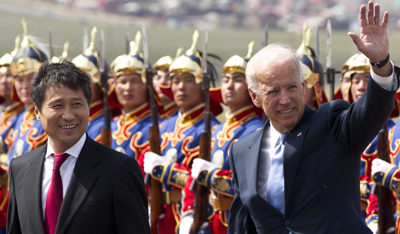 CHENGDU: US Vice President Joe Biden left China on Monday after a five-day visit aimed at boosting confidence in his country's beleaguered economy and headed to its coal-rich neighbour, Mongolia.
Biden flew out of the southwestern Chinese city of Chengdu after pledging that the world's biggest economy would never default on its debts following a historic downgrade this month of the country's top-notch credit rating.
China is the largest foreign holder of US debt, and Biden used the official visit -- his first as vice president -- to assure its leaders that their massive investment remained safe.
Beijing has used the proceeds of its export machine to invest around $1.2 trillion in US Treasury bonds, and the world's second-largest economy last week appealed for global financial stability as panic gripped the markets.
But the country's leaders were conciliatory in their public appearances with Biden, with Premier Wen Jiabao saying his "clear message" had served to boost investor confidence in the United States.
On Monday, Biden will hold talks with Mongolia's President Tsakhia Elbegdorj and Prime Minister Sukhbaatar Batbold before flying to Japan in the evening for the final leg of his Asia trip.
Mongolia is opening up its vast coal reserves to foreign investors, hoping to stimulate growth and pull thousands of people out of poverty in the mineral-rich but still underdeveloped Asian country.
Last month US mining giant Peabody Energy said it was among the firms chosen to help develop a section of the highly coveted Tavan Tolgoi coal mine in the Gobi desert, although later reports said the deal was still under negotiation.
Tavan Tolgoi is one of the world's largest coal fields with 6.4 billion tonnes of reserves, and competition for the government contracts to develop it has been intense.
Sandwiched between China and Russia, Mongolia has traditionally pursued a careful foreign policy that seeks not to alienate its giant neighbours.
But the young democracy has also sought closer ties with the United States and sent troops to both Iraq and Afghanistan.
In June, President Elbegdorj promised to give US companies a role in its booming energy sector during talks in Washington with President Barack Obama.
Biden is the most senior US figure to visit Mongolia since 2005, when then president George W. Bush made a brief stopover in the capital Ulan Bator.
He will attend a demonstration of traditional Mongolian sports -- likely to include archery, wrestling and horse racing, according to his aides -- before flying on to long-standing US ally Japan.
Copyright AFP (Agence France-Presse), 2011






Comments
Comments are closed for this article.