



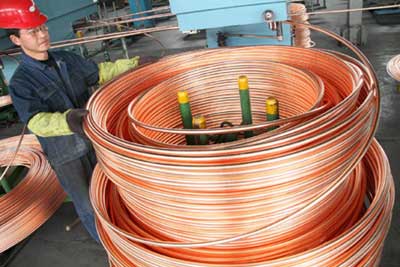
 SHANGHAI: Copper slipped on Friday after rating agency Moody's put Spain's credit rating on review for downgrade, causing the metal to change course after reaching its highest in more than 3 months earlier in the session.
The threat added to negative sentiment over a continued impasse among US lawmakers on a key debt ceiling vote and overcame price support from supply issues in Chile.
Three-month copper on the London Metal Exchange fell 0.2 percent to $9,797.25 a tonne by 0725 GMT after surpassing the peak hit on April 11. But it is on track for a monthly rise of 4 percent, the highest this year.
The most-active October copper contract on the Shanghai Futures Exchange fell 0.1 percent to 72,660 yuan per tonne, also after touching its highest since April 11. Its monthly rise of 3.6 percent will also be the year's highest.
Rating agency Moody's on Friday placed Spain on review for a possible downgrade, citing weak growth and funding pressures, hitting the euro on concerns a Greek rescue package has not laid contagion fears to rest.
The fears have also sent Italy's borrowing costs soaring at a closely watched bond auction on Thursday and dampened recent data tracking economic sentiment in the euro zone.
Persistent political gridlock among US lawmakers also continued to weigh on the financial markets.
US Republican leaders will scramble to rescue their budget deficit-cutting plan on Friday after conservatives mounted a rebellion that heaped uncertainty on efforts to avert a catastrophic debt default.
House of Representatives Speaker John Boehner's failure to round up enough support for his plan exposed a rift in the Republican Party that is hampering efforts to reach a compromise to raise the US debt ceiling before a Tuesday deadline.
Comments by Standard and Poor suggested that the rating agency would probably be convinced to keep US ratings at AAA if lawmakers were to show commitment to solving the debt problem with bold deficit-cutting measures.
SUPPLY DISRUPTIONS CUSHION DOWNSIDE
Downsides in copper were cushioned by supply disruptions, leading to relatively limited losses compared to most base metals futures.
Chile's Escondida mine, which extracts about 7 percent of the world's copper, on Wednesday declared force majeure on copper concentrate sales amid a six-day strike that has hit output at the world's top deposit.
"What's happening in Escondida is keeping prices firm," said Jonathan Barratt, managing director of Commodity Broking Services. "It seems that the strike will be extended. There has been a rash of labour action that has kept copper supply tight and causing concerns."
Chile's copper output tumbled 8.5 percent to 426,477 tonnes in June after a contract workers' strike, heavy rains and power outages hit operations at the world's top copper producer, the government said on Thursday.
The country's copper production is set for another big drop in July after a string of strikes at some of the world's top mines and a harsh winter storm that halted operations across the country's mining heartland.
But the withheld tonnages from Escondida have not significantly tightened the global copper market in the short term. Demand has eased in top consumer China into its traditionally slow third quarter and high prices are deterring restocking for the moment.
"There is just very little spot demand right in China now that premiums are quite meaningless. If you call up trading firms, they'll give you their premium quotes, but no actual deals are being done now," said Shanghai Dongzheng futures trader Du Xiao Hua.
"Importing copper now will result in losses of about 2,000 yuan a tonne given the current LME-ShFE arbitrage."
"There is no difference between the premiums commanded by Chilean copper and normal LME copper now, despite tighter supplies from Chile. There is just very little demand," said Jinrui Futures analyst Zhao Kai.
Copyright Reuters, 2011






















Comments
Comments are closed for this article.