



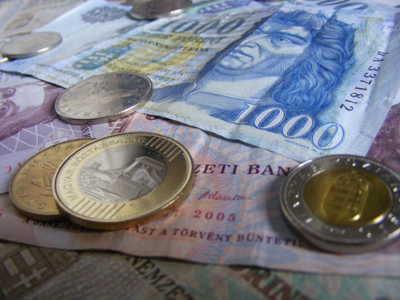
 BUDAPEST: Hungary's forint touched three-year lows against the euro on Monday as a drop in a closely watched manufacturing index underpinned expectations that the country's central bank will begin cutting interest rates again.
The Purchasing Managers' Index for Hungary fell to 50.7 in December, close to the 50 line which indicates economic stagnation, from 55 in November.
"Normally the PMI figures do not have any impact on Hungarian markets but today's figure was so bad that this may be an exception," one Budapest-based dealer said.
The forint traded at 318.99 against the euro at 0848 GMT. After the PMI figures it dived briefly to a three-year low of 321.02, 1 percent weaker than on Friday, but that may have been a trading error, the dealer said.
Further forint easing is still possible as the weak figures, coupled with loose monetary policy in the euro zone and in Central Europe's biggest economy, Poland, feed expectations for rate cuts by the National Bank of Hungary.
"These weak forint levels should justify caution (from the central bank)... (but) if the market perception that they prefer a weak forint is right, this is a good opportunity to weaken it," the dealer added.
While a weaker currency helps fight deflation and economic slowdowns, uncontrolled currency falls are a bigger concern in Hungary than in Poland. That could be indicated by a weakening of Hungarian government bonds while Polish bonds are firming, one Budapest-based fixed income trader said.
Hungary's benchmark 10-year bond yield rose 5 basis points to 3.65 percent, while the corresponding Polish yield fell 4 basis points to 2.4 percent.
"A big forint weakening can affect bonds as well," the trader said, adding that a bond buying programme by the European Central Bank in the euro zone would also support Central European government bonds.
Poland's zloty traded flat at 4.3 to the euro.
The chief economist of the Polish Finance Ministry said that deflation and the risk of euro zone recession may call for "braver monetary policy".
Markets are pricing in about 50 basis points of rate cuts in Poland over the next nine months. But analysts polled by Reuters expect no further easing from the current record low of 2.0 percent.

























Comments
Comments are closed for this article.