



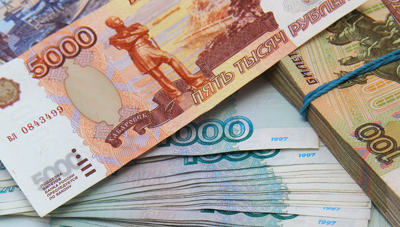
 TOKYO: The embattled ruble clawed back some losses in Asian trade on Wednesday after crashing to unprecedented lows, but market players were not convinced of the authorities' ability to reverse the downward trend.
The Russian currency dived to 80 against the dollar and 100 to the euro Tuesday, testing President Vladimir Putin's ability to ride out both the country's economic storm and his clash with the West.
To make matters worse, the White House announced that US President Barack Obama plans to approve tightening sanctions against Moscow over its Ukraine incursion.
In late afternoon Asian trade, the dollar bought 66.80 rubles while the euro fetched 83.38 rubles.
The Russian central bank raised its key interest rate to 17.0 percent from 10.5 percent in a bid to prop up the currency, but the move "has failed to stabilise the ruble", said Sebastien Barbe, head of emerging market research and strategy at Credit Agricole.
The rate rise and plunging oil prices suggest "a meaningful recession next year", Barbe said in a note.
Moscow's central bank said Wednesday it had spent $1.96 billion on Monday in a bid to prop up the currency. The regulator has spent more than $10 billion from its currency reserves since the start of the month and has been harshly criticised for its failure to halt the ruble's fall.
"Further depreciation pressure suggests that rate hikes and FX intervention may not be enough," Barbe said.
"At the current juncture, the odds of targeted capital controls are increasing significantly."
The almost halving of crude oil prices in the past six months has been devastating for Russia's economy, which is heavily dependent on exports of natural resources.
The euro, meanwhile, was mixed after surprise data Tuesday depicted a eurozone economy holding up better than feared. The 18-nation bloc reported a record trade surplus and the ZEW index for German investment sentiment improved.
The common European currency bought $1.2489, against $1.2511 in New York, while it edged up to 146.22 yen against 145.86 yen.
The Japanese currency was firm on safe-haven buying, with the dollar at 117.07 yen, up from 116.59 yen in US trade but still down from 117.39 yen in Tokyo earlier Tuesday.
Investors are awaiting the outcome of the Federal Reserve's monetary policy meeting later Wednesday. The Fed is expected to adjust its forecasting language to allow a better understanding of its plans for an interest rate rise.
The Indonesian rupiah, which earlier this week tumbled to its lowest since August 1998 during the Asian financial crisis, picked up slightly with the dollar at 12,731 rupiah against 12,772 on Tuesday.
The greenback was mixed against other Asia-Pacific currencies.
It weakened to Sg$1.3042 from Sg$1.3083, and to 44.73 Philippine pesos from 44.81 pesos.
The US unit firmed to 1,094.98 South Korean won from 1,086.66 won, to Tw$31.32 from Tw$31.27, to 63.65 Indian rupees from 63.49 rupees, and to 33.01 Thai baht from 32.94 baht.
The Australian dollar weakened to 81.55 US cents from 82.30 cents, while the Chinese yuan bought 18.88 yen against 18.92 yen.

























Comments
Comments are closed for this article.