



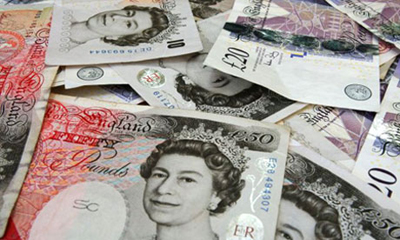
 LONDON: Sterling sank more than half a percent against the euro on Tuesday after a batch of weaker data on industry and manufacturing added to a worsening outlook that is set to delay any rise in interest rates next year.
Output for industry overall fell 0.1 percent after a strong September, the Office for National Statistics said on Tuesday. Manufacturing output dropped 0.7 percent, hit by a sharp fall in computer, electronic and optical products.
That reinforced expectations that rates in Britain are likely to stay low for quite some time; investors do not expect the Bank of England to raise official borrowing costs until late next year or early in 2016.
Sterling recovered against a weakening dollar as the day wore on to finish up a third of a percent at $1.5705, but fell 0.6 percent to 79.15 pence per euro.
"It is continuing economic disappointment and political uncertainty ahead of the election next year, which no-one likes," said Neil Mellor, a strategist at Bank of New York Mellon in London.
The dollar was lower across the board on Tuesday after some strong gains following U.S. jobs numbers last Friday. Mellor said the volatility of trade into the end of the year would be boosted by some swift pullbacks to any major move as players sought to lock in profits.
"Sterling is going to go lower against the euro and that is largely a position thing. So many people are short (euros) that there is more room for people to build short positions in sterling than in euro," he said.
"People are also very inclined to take profit where they can. That is more true as we approach the end of what has been a pretty good year for many."
Maher added that in a day without much other meaningful data, the market had probably paid more attention to the UK numbers than would normally be the case.
They had been better news earlier for the pound in data showing a "Black Friday" shopping spree pushed British retail sales growth to a three-month high in November.
The pound has underperformed the dollar in recent months on expectations the U.S. Federal Reserve will hike rates before the BoE.
"The market has been trying to push UK rate hike expectations further into the future, but it seems that even as it does that, we still manage to come up with disappointing numbers that force you to (push them out) even further," said Daragh Maher, a currency strategist at HSBC.
The yield gap between two-year U.S. Treasuries and British gilts hit its widest since September 2012 on Monday, Reuters data showed, helping underpin the dollar.




















Comments
Comments are closed for this article.