



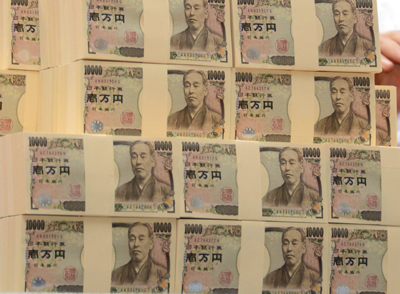
 LONDON: The yen rose on Wednesday after Japanese Prime Minister Shinzo Abe voiced concern about the economic impact of its fall to a six-year low, adding to the sense of a halt this week in the dollar's record-breaking run since July.
The U.S. currency slipped 0.3 percent on the day to 108.60 yen after the Jiji news service quoted Abe as saying he would carefully watch the impact of the yen's recent weakness on Japanese regional economies.
The prime minister's comments follow similar expressions of concern from two of his ministers after a drop of roughly 7 percent since early August which took the yen to a low of 109.46 yen per dollar last Friday.
Much as that seems broadly part of Abe's plan to refloat the Japanese economy by spurring inflation, market players said the speed of the fall may not be so easy for policymakers to digest.
"It seems to us - and I think most people - that it's not the fact of the move, just the pace of it that Tokyo is concerned about," said a spot dealer with one large international bank in London.
"(But) it is not a surprise that we're seeing the yen show some resistance at the moment, given the slight pullback we've seen on the dollar in the last few days."
The dollar's heaviest falls came against the New Zealand and Australian dollars, but there were also more signs of life from the euro, which fell only briefly in response to a worse than expected business sentiment report from German think-tank Ifo.
The single currency was unchanged on the day at $1.2847.
"The issue we have been discussing is whether the halt we've seen this week will develop into a correction and there are signs, notably on equities markets, that there is scope for it," said Ian Stannard, head European FX strategy at Morgan Stanley in London.
"That could explain why the Aussie and Kiwi have done so well today, but if it is going to bed in I would watch the low yielders most closely, particularly the yen."
The dollar has racked up 10 weeks of gains against a basket of currencies on the back of growing conviction among investors that the Federal Reserve will begin to tighten monetary policy with higher interest rates next year.
Both Europe and Japan are still expected to head further in the opposite direction, prompting a number of major banks to predict the euro will fall as low as $1.10-1.15 in the next year, or even to parity.
The dollar was steady at 84.667, near a four-year high of 84.861 set on Monday.
"A lot of hedge funds were taking profits after the dollar's recent rise," foreign exchange research firm Global-info Co director, Kaneo Ogino, said. "But other investors see an opportunity to buy the dollar on dips."
























Comments
Comments are closed for this article.