



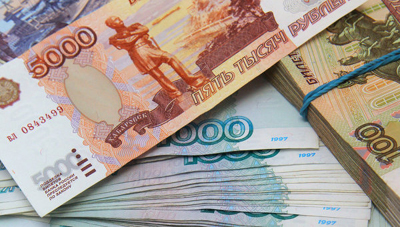
 MOSCOW: Russia's rouble currency hit a new low against the dollar on Monday, hit by falling oil prices and a decision by the central bank not to raise interest rates despite investor concern over the economic effect of the Ukraine crisis.
Russian assets took a beating last week after the United States and European Union imposed new sanctions over Moscow's role in the separatist conflict in Ukraine, further limiting access to foreign capital for some of Russia's top companies.
In the first hour of trading on Monday, the rouble fell to a new all-time low of 38.00 roubles per dollar. By 0900 GMT it had extended losses to trade 0.81 percent weaker against the dollar at 38.09 and 0.55 percent lower at 49.21 versus the euro.
"There are three factors weighing on the rouble: emerging-market currencies are under pressure, oil prices are weak and the Russian central bank did not raise rates last week," VTB Capital foreign exchange analyst, Maxim Korovin, said. Global oil benchmark Brent slumped to a more than two-year low on Monday as lacklustre economic data from China, the world's top energy consumer, cast a shadow on the outlook for oil demand amid abundant global supplies. Russia relies on oil and gas for about two-thirds of exports and half of federal budget revenues.
Korovin said the rouble might fall still further over the coming week, noting that rates for Russian companies looking to park their foreign currency holdings at the central bank remain low, reflecting weak demand.
The Russian central bank left its key interest rate on hold at a regular meeting on Friday, signalling a dovish shift in policy which may mean that a recent cycle of rate hikes is over.
The bank aims to move to a freely floating rouble this year.
Emerging market currencies are under pressure as markets have brought forward the risk of an earlier interest rate hike by the US Federal Reserve, making lower-risk assets more attractive.
The rouble has weakened about 15 percent against the US currency this year, spurring inflation, which was running at an annualised 7.6 percent in August, well above the central bank's official 5 percent target.
An added worry for investors in Russian assets is that President Vladimir Putin has said Russia is considering how to retaliate against the latest round of Western economic sanctions.
"If our government refrains from radical steps, we can expect the (rouble-dollar) pair to return to 37.50," Golden Hills Capital investment firm's chief analyst, Natalia Samoilova, said in a note.
Russia retaliated to an earlier round of sanctions by banning food imports from many Western countries.
Ratings agency Moody's said on Monday that the latest Western sanctions are credit negative for Russia as they exert pressure on the economy's long-term growth potential and may undermine its fiscal and external position.
Moscow-listed shares also fell on Monday, with top lender Sberbank - seen as a barometer for the wider Russian economy - down 1.1 percent after being included in the latest round of US sanctions.
The dollar-denominated RTS index eased 1 percent to 1,200 points by 0900 GMT, while its rouble-based peer MICEX traded 0.5 percent lower at 1,451 points.




















Comments
Comments are closed for this article.