



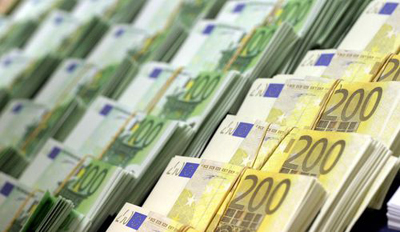
 LONDON: The euro fell broadly on Wednesday, hitting a 19-month low against the Swiss franc, as speculation that the European Central Bank will resort to quantitative easing was fuelled by yet more bad news from the euro zone.
The common currency also hit a 13-month low against the dollar of $1.3151 earlier on Wednesday, though it recovered a little in European trade to $1.3179.
The euro has been hit in recent weeks by a slew of weak data from the euro zone, where inflation fell to 0.4 percent in July and is expected to have fallen to 0.3 percent in August in data published on Friday. That is far below the ECB's "danger zone" of 1 percent, let alone its target of just under 2 percent.
ECB chief Mario Draghi fuelled speculation that monetary policy would be further loosened in the euro zone over the weekend by saying the central bank would use "all the available instruments" to deal with the threat of deflation at the U.S. Federal Reserve's annual conference in Jackson Hole.
Developments on Wednesday only worsened the picture for the euro zone: data showed German consumer morale fell for the first time in 1-1/2 years, while Italy's economy minister said the country must cut its growth forecast.
The euro hit 1.20715 Swiss francs on trading platform EBS, its lowest since January 2013. A sustained drop could test the Swiss National Bank's three-year-old pledge to cap the franc at 1.20 per euro, made in order to fight the risk of deflation.
Some traders said that despite a bleak picture in the euro zone, the move higher for the traditionally safe-haven Swiss currency was surprising, given a slight de-escalation of tension in Ukraine and Gaza.
An open-ended ceasefire in Gaza held on Wednesday after seven weeks of fighting between Israel and the Palestinians, while Ukrainian President Petro Poroshenko promised to work on an urgent ceasefire plan after negotiations with Russia's leader Vladimir Putin.
"On paper you would have thought the Swiss franc would be weakening because ... it feels like we've had a reduction in geopolitical risk," said Daragh Maher, a currency strategist at HSBC in London.
QE OR NOT QE?
The euro's slide against the Swiss franc followed a drop in German 10-year Bund yields to an all-time low of 0.916 percent.
Some said markets had got ahead of themselves in expecting quantitative easing - effectively the printing of new money - in the euro zone.
"Our contention is that Draghi and the ECB are turning more dovish, but nowhere near as dovish as the market has interpreted it post-Jackson Hole," said Adam Myers, head of foreign exchange strategy at Credit Agricole in London.
Earlier on Wednesday, the euro touched its lowest level in nearly 10 months against the Australian dollar at A$1.4104 . Against the Canadian dollar, the euro set a nine-month low of C$1.4362.
The New Zealand dollar was the biggest mover among developed currencies, rising just over 0.5 percent to $0.8377, after giant cooperative Fonterra announced a partnership with a Chinese food manufacturer to sell milk in China. Dairy is New Zealand's largest export earner.
The dollar index, which measures the greenback against a basket of major currencies, edged back slightly after having hit a 13-month peak of 82.727 in Asian trade.




















Comments
Comments are closed for this article.