



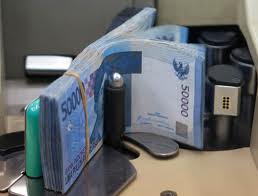
 SINGAPORE: The rupiah turned weaker on Monday after Indonesia's second largest party, Golkar, unexpectedly said it would support the main rival to presidential frontrunner Joko "Jokowi" Widodo, while the Malaysian ringgit led gains among emerging Asian currencies.
Golkar sprang a surprise by announcing it would support former general Prabowo Subianto in July's presidential election, even though "Jokowi" named Golkar senior party official and former vice president, Jusuf Kalla as his running mate.
The rupiah had risen as much as 0.6 percent to 11,338, its strongest since April 10, after "Jokowi" brought Kalla onto his ticket.
But Golkar's subsequent announcement of support for Prabowo knocked both te rupiah and drove Jakarta shares down about 1 percent, due to increased political uncertainty.
The rupiah's non-deliverable forwards also fell.
"This is definitely negative for IDR assets," said Dariusz Kowalczyk, a senior economist and strategist for Credit Agricole CIB in Hong Kong.
"This introduces confusion and uncertainty to the race and lowers odds for a strong coalition."
The rupiah was the best performing emerging Asian currency so far this year due to prospects of a straightforward victory for Jokowi in the presidential election on July 9.
Other emerging Asian currencies, however, rose with the Malaysian ringgit at a six-month high after data showed stronger-than-expected growth and a wider current account surplus.
India's rupee touched an 11-month high on expectations of sustained capital inflows after the Bharatiya Janata Party swept the country's elections, even though traders said the central bank was spotted intervening to stem gains.
The Philippine peso advanced on firm stocks.
South Korea's won gained in thin trading on continuous stock inflows and exporters' demand.




















Comments
Comments are closed for this article.