



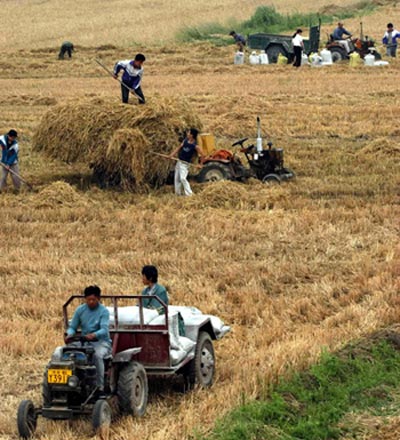
 UNITED NATIONS: The UN Food and Agriculture Organization (FAO) on Monday launched a new initiative to grow more food to feed world's growing population in an environmentally sustainable way. The agency notes in a news release that there is no option but to further intensify crop production in order to feed a world population projected to reach 9.2 billion by 2050. To eradicate hunger and meet demand by 2050, food production needs to increase by 70 per cent in the world and 100 per cent in developing countries, it adds.
"The key to meeting the challenge lies in sustainable crop production intensification, or Save and Grow," FAO states, referring to the new approach that is outlined in a book by the same name and published by FAO's Plant Production and Protection Division. The Save and Grow model "applies external inputs at the right time and in the right amount - no more and no less than plants need," says the agency. Green Revolution technology produced more than enough food for a world population that doubled from three to six billion between 1960 and 2000, FAO states, while pointing out that it focused on raising crop production without much attention to the environment.
The new approach draws partly on conservation agriculture (CA) techniques which do away with or minimize ploughing and tilling, thus preserving soil structure and health. The Save and Grow toolkit also includes elements such as precision irrigation, which "delivers more crop for the drop", and "precision placement" of fertilizers, which can double the amount of nutrients absorbed by plants. Another element is integrated pest management, whose techniques discourage the development of pest populations and minimizes the need for pesticides.
"Such methods help adapt crops to climate change and not only help grow more food but also contribute to reducing crops' water needs by 30 per cent and energy costs by up to 60 per cent," notes FAO. The new approach, the agency also points out, will require significant support to farmers so they can learn the new practices and technologies, while governments will also need to strengthen national plant-breeding programmes and overall domestic and foreign investments to the agriculture sector need to be increased.
Copyright APP (Associated Press of Pakistan), 2011





















Comments
Comments are closed for this article.