



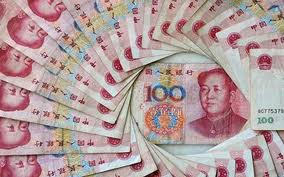
 SHANGHAI: China's yuan remained little changed on Tuesday, with rate volatility remaining at its lowest level in more than three years as the central bank kept the currency on a tight leash.
The central bank weakened its official midpoint slightly on Tuesday to 6.1352 per dollar after the dollar index rose mildly in overnight trade, but the spot yuan maintained the flat, range-bound trajectory it has been on since early November.
The yuan opened at 6.0926, a mere three pips stronger than Monday's close.
Realized market volatility has pancaked this week, setting its lowest point since mid-2010 -- when the People's Bank of China effectively froze the exchange rate in reaction to the global financial crisis -- at Monday's close.
Volatility remained within a few pips of Monday's record at midday Tuesday.
Traders say the central bank has been acting through intermediary state-owned commercial banks to buy dollars off the market, capping appreciation pressure caused by steady capital inflows.
This has resulted in excess yuan-denominated cash pouring into the interbank market, which the central bank has mopped up during open market operations.
The yuan overtook the euro in October to become the second-most used currency in trade finance, global transaction services organisation SWIFT said on Tuesday.
The market share of yuan usage in trade finance, or Letters of Credit and Collection, grew to 8.66 percent in October 2013. That improved from 1.89 percent in January 2012.
The yuan, also known as the renminbi, now ranks behind the US dollar, which remains the leading currency with a share of 81.08 percent.
The yuan remained the 12th payments currency of the world, with a slightly decreased share of 0.84 percent compared with 0.86 percent in September.


























Comments
Comments are closed for this article.