


SBP keeps policy rate unchanged at 14 percent

KARACHI: The State Bank of Pakistan has decided to keep its policy rate unchanged at 14.0 percent. This was announced by Shahid H. Kardar, Governor, State Bank of Pakistan, while unveiling the Monetary Policy Statement at a press conference held at SBP, Karachi today.
“SBP is also aware of the delicate balance that needs to be struck between risks to inflation and economic growth and therefore has decided to keep the policy rate unchanged at 14 percent for the time being,” Kardar said while explaining the rationale behind keeping the policy rate unchanged. The future course of policy action would be contingent upon expected progress of key areas of concern to State Bank, he stressed.
Kardar listed the following three developments that provide comfort to the State Bank:
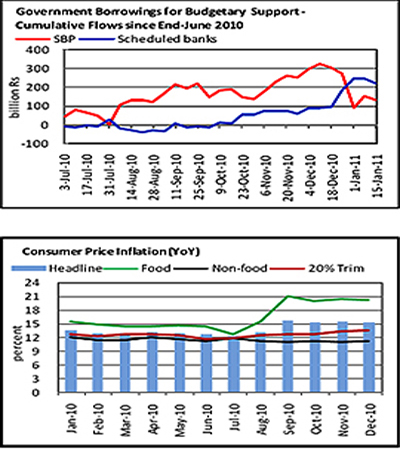
? First, SBP anticipates that the current shift away from SBP financing will be consolidated since an understanding has been reached with the government that it will restrict its borrowings from the SBP to below the end September stock of Rs1290 billion.
? Second, an external current account surplus in H1-FY11 is somewhat rare in Pakistan and is a marked improvement over earlier projections. This indicates that the risk of fiscal problems slipping into external account has not materialized so far, thereby providing an opportunity to address the persistent fiscal issues.
? Third, SBP is optimistic that the recent multi-partisan efforts will improve fiscal revenues and curb current spending (one-off and continuous).
Talking about current state of the economy, SBP Governor said that delays in crucial economic reforms had increased challenges for the management of the economy. Despite high interest rates, the fiscal deficit and borrowings from the banking system was continuing to stoke inflationary pressures, he said and added that this was impeding economic recovery and increasing the debt burden of the country. However, an improved external current account and stable financial markets allow for some optimism, he said. “Under these challenging circumstances, a proactive monetary policy is necessary but not sufficient to tackle high and persistent inflation,” Kardar said.
He pointed out inflationary pressures that were already high at the beginning of FY11, and have remained at elevated levels during first half of FY11. In December 2010, year-on-year CPI inflation was 15.5 percent while its average for H1-FY11 stands at 14.6 percent, he said and added that not only did the contributing factors of inflation continued to prevail in H1-FY11, the economy also experienced an additional shock in the form of unprecedented devastating floods.
SBP Governor said that the revised projection of average CPI inflation for FY11 falls in the range of 15 to 16 percent, along with high probability of double digit inflation in FY12. “To bring inflation under better control, the critical measures would be fiscal consolidation and reduction in fiscal deficit and government borrowings from SBP,” he said and added that these measures would support SBP’s efforts to contain monetary expansion and thus ease aggregate demand pressures.
SBP Governor stressed upon the Federal Government to spell out a clear and coherent strategy to limit fiscal slippages. “This is all the more important given that the proposed reforms in the GST along with other tax measures have been postponed,” said and added that in January 2011, the government also reversed the decision of increasing retail prices of petroleum products. “Apart from adversely affecting revenue collections and increasing expenditures on subsidies, these actions have made it difficult to raise external resources for budget financing,” he added.




















Comments
Comments are closed for this article.