



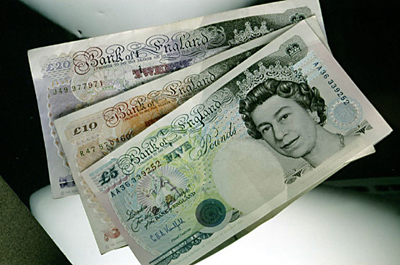
 LONDON: Sterling climbed against the dollar and pulled away from a near two-month low against the euro on Friday after data showed the British economy picked up pace in the third quarter. But gains were limited given the growth rate of 0.8 percent met expectations and was priced in by many investors.
Against the dollar, sterling was up 0.1 percent at $1.6215, compared with $1.6207 before the data was released. Sterling gained 6 percent in August and September, rising to $1.6260 on Oct. 1, its highest since early January.
It is up nearly 10 percent since hitting a three-year low of $1.4814 on July 9, bolstered by data showing the UK economy on a sustainable growth path and the Federal Reserve's ultra-easy monetary policy. Against the euro, sterling recovered from near two-month lows struck on Thursday.
The euro cut gains to trade flat at 85.20 pence after the data, down from 85.26 beforehand.
"The reaction in sterling was fairly muted given the data was in line with expectations.
The growth is being led by the services sector with manufacturing also showing a bit of a recovery," said Chris Walker, currency strategist at Barclays.
"We think sterling will trade flat in the near term and while there will be support at lower levels we are sceptical it can gain further from here against the dollar." Part of the reason why investors are turning cautious is that positive data surprises are waning and hence their impact on the pound are likely to fade.
Also given the BoE has pledged to keep interest rates anchored and policy accommodative, fund managers say the scope for further gains is rather limited.
But any dips towards $1.60 would be bought into by reserve managers for a move higher, possibly targeting this year's high of $1.6380 in the next few months.
"Sterling should remain resilient against dollar, euro, the yen and the Swiss franc," said Valentin Marinov, currency strategist at Citi.
"A continuation of the dollar selloff could see sterling/dollar moving higher still from current levels." While the British economy is still on track for a durable recovery, the US economy seems to losing momentum after a 16-day government shutdown and the euro zone has only just emerged from a recession.
The BoE said it would consider tightening interest rates when the jobless rate fell to 7 percent, and that this could take three years. Governor Mark Carney said on Thursday that the BoE also intends to provide more generous liquidity than before, all of which is likely to keep market interest rates subdued and make buying the pound less attractive.
Persistently strong data in the past few months has pushed up sterling overnight interbank average rates (SONIA) , which form the basis of lending to the wider economy.
The SONIA rates are pricing in a slim chance of a hike in the 0.5 percent bank rate as early as the first half of 2015.
The 18-month SONIA rate rose to 0.50125 percent on Friday, from around 0.4825 percent earlier this week. A rate above 0.5 percent indicates investors are pricing in a chance of a rate hike.




















Comments
Comments are closed for this article.