



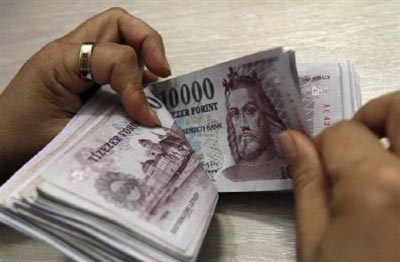
 BUCHAREST: Benchmark Polish bond yields fell to a record low on Monday and Hungarian bonds and the forint rose on Asian investment inflows after the Bank of Japan embarked on a massive stimulus drive.
Polish Deputy Finance Minister Wojciech Kowalczyk said inflows to the debt market from Asia had risen significantly after Japan's decision to aggressively ease monetary policy, which boosted Polish debt and the zloty on Friday.
Bonds extended those gains on Monday, and the 10-year yield fell to an all-time low of 3.48 percent. They were at 3.51 percent at 1031 GMT, 11 basis points lower than on Friday.
"Foreign players are driving Polish yields lower. Domestic players also joined in as stop-losses hit," a Warsaw-based fixed income dealer said.
The zloty was 0.4 percent higher at 4.14 per euro, near Friday's two-week high as Polish markets looked ahead to an interest rate decision on Wednesday.
Analysts expect the central bank to keep interest rates on hold at a record low of 3.25 percent.
Its decision and comments will be closely watched, however. Market interest rates factor in an additional two quarter-point rate reductions, as many dealers and investors say they expect economic data in coming months to prove worse than the bank forecasts.
HUNGARY ASSETS FIRM
In Hungary, short-term worries over central bank policy have subsided for now, while the Japanese stimulus was driving bonds and the currency up.
The new central bank governor, Gyorgy Matolcsy, last week launched plans to help small and medium-sized businesses survive recession with cheap credit, which confirmed speculation he would pursue pro-growth policies.
But they did not go as far as some analysts had expected, easing some fears on markets about the policies.
The bank's deputy governor, Julia Kiraly, resigned on Monday in protest that the new governor changes could damage the bank and the economy, limiting gains in the forint.
The forint was up 1.1 percent from Friday at 1012 GMT, after earlier hitting a one-month high at 296.45 to the euro. Bond yields fell 16-20 basis points, with 10-year paper trading at 5.82 percent.
"As the forint rebounded, all of a sudden everybody's coming back into bonds as well," a trader said.
"Those who have delayed buying due to the uncertainty in the forint and feared that the forint might fall further are now coming in."
The Czech crown was a touch lower after industrial output fell by 5.7 percent year-on-year in February as the country suffers its longest recession in two decades.




















Comments
Comments are closed for this article.