



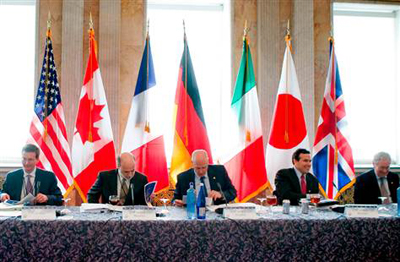
 WASHINGTON: Japanese Finance Minister Yoshihiko Noda on Thursday urged G7 countries to take appropriate action on currencies when needed, as the country struggles with the damage from last month's devastating earthquake and tsunami.
The G7 finance leaders discussed Japan's earthquake, Europe's debt woes and the political situation in the Middle East and North Africa as risks to the global economy, Noda told reporters.
"I expressed gratitude to the G7 countries for cooperating in the joint currency intervention on March 18. I also asked the G7 countries to continue to take appropriate action together while closely watching markets," he told reporters after a meeting with his G7 counterparts.
The Group of Seven developed nations met behind closed doors on Thursday evening, followed by talks by the larger Group of 20 rich and emerging countries. The G20 is expected to issue a communique after its second day of talks on Friday.
Noda said G7 nations agreed that the March intervention was effective in curbing excessive and disorderly exchange-rate moves. But he said there were no specific discussions within the group on future possible action in the foreign exchange market.
The G7 -- the United States, Britain, Canada, France, Germany, Italy and Japan -- conducted a rare coordinated intervention in currency markets last month after the yen strengthened sharply following the earthquake.
Noda also spent most of his time discussing the March currency intervention when he met European Central Bank President Jean-Claude Trichet on Thursday, a senior Japanese finance ministry official said. The two did not discuss Japan's monetary policy, the official said.
The Japanese finance minister expects to meet US Treasury Secretary Timothy Geithner for bilateral talks on Friday.
Japan is facing its worst crisis since World War Two after the 9.0 magnitude earthquake and a tsunami battered its northeast coast last month, crippling a nuclear power plant and disrupting factory output with power and parts shortages.
At the G20 working dinner, Noda said he explained that there were various uncertainties over the impact of the quake and the nuclear power crisis on the economy, such as the damage to business and household sentiment as well as the effect of power supply shortages on corporate activity.
He then pledged to provide sufficient information to the global community on the nuclear crisis, and that Japan will continue on its path toward restoring medium- to long-term fiscal health.
Bank of Japan Governor Masaaki Shirakawa, who was also present at the G7 and G20 gatherings, said Japan's earthquake was cited by a G7 member country as among the risks to the global economy.
"Japan was hit by such a big earthquake so it would be among the risks. But I didn't get the sense that the earthquake was singled out as a major risk," Shirakawa told reporters.
The G20 finance leaders, in a full day of talks on Friday, will discuss the risks to the global economy and aim to seek common ground on how to shrink global imbalances for fostering sustainable growth.
Geithner told a conference on Thursday that despite the risks in oil, the financial challenges in parts of Europe and Japan's quake, there was a "gradual strengthening in confidence" that the world economy will grow at a reasonable rate.
That feeling seems to be shared by G20 members, according to the Japanese finance ministry official, who said the outlook for global growth was generally upbeat despite Japan's quake, Europe's debt woes and political instability in North Africa.
"The tone (within the G20) is that the global economic recovery is actually stronger than expected, but that the three risks are emerging," he said.




















Comments
Comments are closed for this article.