



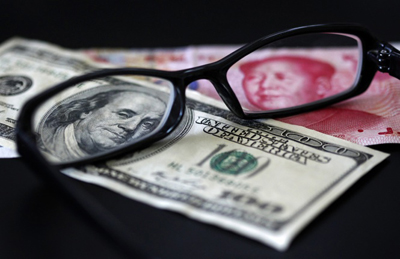
 BEIJING: China's foreign exchange reserves soared to a record at more than $3 trillion at the end of the first quarter, and its money growth blew past forecasts in March, threatening to aggravate the nation's inflation woes.
Chinese banks extended 679.4 billion yuan ($104.0 billion) in new local currency loans in March, while the broad M2 measure of money supply rose 16.6 percent from a year ago, both above market expectations.
Tapping the brakes on money and lending growth has been a crucial part of Beijing's campaign to rein in inflation, which probably hit a 32-month high of 5.4 percent in the year to March, according to local media reports.
After making progress at the start of the year in mopping up excess cash, the People's Bank of China appeared to lose some ground in March.
"The latest numbers show that it is still too early for China to ease monetary tightening. China still needs to keep tightening policy at the current pace in coming months," said Qu Hongbin, chief China economist with HSBC.
A measure of the difficulties faced by China in taming inflation came in the first quarter's nearly $200 billion increase in its foreign exchange reserves, already the world's biggest, to $3.05 trillion.
Although China's vast reserves are often seen as a sign of the strength of its economy, the growing pile, stemming in large part from its vast trade surplus, translates into money creation and inflationary pressure at home.
China has raised benchmark interest rates four times since last October and has required the country's big banks to lock up a record high of 20.0 percent of their deposits as reserves.
Economists polled by Reuters last week said that China was heading for a pause in its half-year cycle of monetary tightening, forecasting that it would raise interest rates just once more this year.
Looking at the first quarter as a whole, the central bank was grasping the nettle in controlling loan issuance, said Liu Hongke, economist with CCB International Securities in Beijing.
She noted that the 2.24 trillion yuan in new loans in the first three months of the year was about 30 percent of the government's full-year target, exactly in line with where it wanted to be at this stage.
"It shows the central bank is doing a good job," Liu said. But she added that China would need to raise banks' required reserves again very soon to absorb excess liquidity.




















Comments
Comments are closed for this article.