



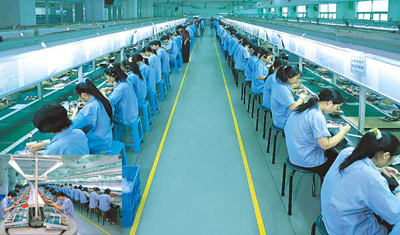
 BEIJING: Electronics and auto makers in China are facing a severe shortage of components after Japan's twin disasters disrupted production, but the full impact will not be felt for weeks, analysts say.
The earthquake and tsunami that devastated Japan's north eastern coast on March 11 shattered infrastructure, caused power outages and forced temporary factory shutdowns -- meaning shipments of key parts to China also stopped.
"As many Chinese manufacturers have started drawing down inventories of components, more significant output loss... shall start showing in the next couple of weeks," IHS Global Insight senior analyst Ren Xianfang told AFP.
Japan is a key supplier of components and equipment used in the assembly of cars, laptops, iPods, refrigerators and flat-screen televisions, and the country accounts for about 14 percent of China's imports, according to UBS.
"Given the importance of Japan in the supply chain of some electronics, chemicals and machinery products... we expect China's related exports to the world might be affected as well," UBS economists said in a research note.
The full impact of the supply problems will start to be seen in the coming weeks as electronics and auto makers use up the parts in stock and Japanese assembly lines remain idle or operate well below capacity, analysts say.
Some electronics companies have reported shortages due to the disasters, and prices of computer memory chips and semiconductors have risen sharply in the past month due to the supply crunch.
Personal computer maker Dell said last week it had experienced "relatively small" supply chain disruptions, while Chinese telecom equipment maker ZTE said last month it expected supply problems to last for three to six months.
Chinese computer giant Lenovo warned last month that supplies of its newly released tablet computer LePad could be restricted after Japan's quake and tsunami disrupted production of memory chips.
But Lenovo president and chief operating officer Rory Read told Dow Jones Newswires that the company had closed holes in its supply chain.
Research firm IHS iSuppli said that Apple could also face shortages of components for its new iPad 2.
"The impact is significant but hard to estimate," Andy Xie, an independent economist in Shanghai, told AFP.
"We know the auto sector is already being hit."
But Japanese car makers Honda, Toyota and Nissan told AFP their assembly lines in China were operating normally -- so far.
"For now there is no change in the whole (year) production target," said Honda Motor (China) Investment Co. spokesman Zhu Linjie.
"However, it cannot be ruled out that we may make interim adjustments to production."
Dongfeng Nissan Passenger Vehicle Company -- Nissan's joint venture with China's Dongfeng Motor Group -- said some suppliers in Japan had been "severely impacted" by the disasters and it was "taking countermeasures" to keep assembly lines running.
The China Chamber of Commerce for Import and Export of Machinery and Electronic Products said imports of luxury cars, memory chips, precision instruments and other key components would be "most affected" by the disasters.
Manufacturers may be able to source some devices from the United States and Europe -- at a much higher price -- but non-Japanese suppliers of "high-specification components" would be hard to find, said Ren.
"I believe (the shortage) will be temporary -- two to three months of very tight supply -- but it depends on Japan," Kevin Wang, director of China research at IHS iSuppli, told AFP.
"If Japan keeps on having earthquakes I think the shortage will last longer," said Wang, after the latest in a series of powerful aftershocks rocked the country.
But the impact on China's gross domestic product would be limited given shipments to Japan account for only two percent of China's economy, IHS Global Insight said.
"It has more of a corporate impact," said Ben Simpfendorfer, managing director of economic consultancy firm China Insider.
"There will be corporate whose quarterly earnings look worse for wear but I certainly wouldn't be slicing GDP forecasts as a result."




















Comments
Comments are closed for this article.