



 NAPLES: NATO is being "particularly careful" with its air strikes in Libya as government troops have begun using civilians as human shields, the deputy commander of operations said Wednesday.
"Libyan government forces have increasingly shifted to non-conventional tactics, blending in with road traffic and using civilian life as a shield for their advance," Rear Admiral Russell Harding said at a news conference.
"NATO forces have been particularly careful to avoid injury to civilians who are in close proximity to the fighting, often precisely because of the tactics of government forces," he said at the base in Naples overseeing operations.
The mandate to protect the local population in these conditions was more challenging because of the stipulations of the UN Security Council resolution approving the mission, which explicitly rules out the use of ground troops.
"Because we are not allowed forces on the ground there is a physical limit to what we are able to do in that respect.
"That doesn't mean to say we don't have the will, intent and fire power to take action to stop it," he said.
The British Royal Navy officer said Libyan forces using these new tactics were moving eastwards "in the direction of Ajdabiya, posing a direct threat to that city and beyond that to Benghazi."
"In response, NATO has pursued direct strikes on advancing forces and their logistics and munitions supply chains," he said.
"NATO has also used surgical air strikes to sever the main supply route between Ajdabiya and Misrata," he said, referring to the city of 500,000 in western Libya that has been besieged by Qadhafi's forces for more than a month.
After the NATO alliance was forced onto the defensive after rebels urged the alliance to do more to protect Misrata, Harding said a "substantial number" of heavy vehicles and tanks had been destroyed in the area on Tuesday.
But he said it was very difficult to destroy tanks in built-up areas without harming local residents who were being used as human shields.
"If you're trying to protect human shields when there is a tank with dozens of people around it -- innocent civilians -- the best thing at that stage is probably not to drop a bomb on that tank," he said.
Harding said rebels in some areas may be "nervous" if they don't see NATO planes flying overhead for several hours, but the operation had an eye on the whole country, including ammunitions depots and oil installations.
Referring to a controversy over NATO taking sides in the conflict in Libya, he added: "We will attack any forces that mean to harm innocent civilians."
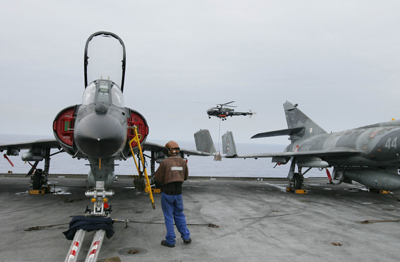
Harding said more than 100 fighter jets and support aircraft have been deployed, as well as a dozen warships all operating under NATO command.
When quizzed over rebel reports that NATO ships blocked boats carrying aid and arms from arriving in Misrata Tuesday, Harding said the rumours were false: "I think you'll find at the end of the day no vessels were detained by NATO."
As the NATO fleet continued to patrol the coasts of Libya and North Africa, refugees fleeing the violence have been taking to rickety fishing boats to attempt the hazardous journey to Italy.
Faced with questions over NATO's role in helping the refugees, Harding said that "if there are lives at threat at sea and you are nearby it is your duty to take action on that."
However, he added: "It is not part of NATO's mission at the moment to go and look for those who want to leave North Africa and go across the Mediterranean. The point of arrival is a national issue."




















Comments
Comments are closed for this article.