


China has its own unique economic model: Ambassador Masood Khan

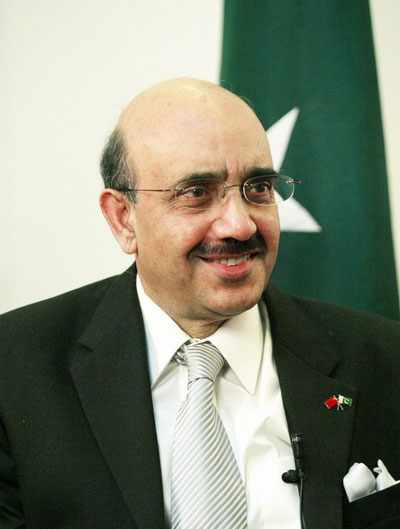 BEIJING: China has its own unique economic model with its own distinct characteristics.
"It will be better off if it continues to stick to its distinctive model which has already creatively and innovatively imbibed the best qualities of the two dominant models of the 20th century socialism and capitalism and merged them with China's traditional economic ethos and cultural mores," said Pakistan's Ambassador to China, Masood Khan.
Ambassador Khan wrote this in an op-ed: Universal values of China's development model: My impressions published in Chinese language in the recent edition of China's prestigious Chinese Academy of Social Sciences journal here.
Khan said this model has given a decisive edge to China in the past thirty years. As China increases its Overseas Direct Investment (ODI) in Asia, Africa, and Latin America, this model may well be studied in those regions and applied, after necessary adaptation, to accelerate growth in a stable and harmonious environment.
He held that most striking feature of China's unique development model is that no country in human history has developed so fast in such a short time on such a massive scale.
No country has lifted such a large number of people out of poverty and raised their living standards in such a short span, he added.
Ambassador Khan observed that with an average growth rate of more than 9 per cent over the past 30 years, China's GDP has risen to US $ 5 trillion, making it the second largest world economy.
Last year, Khan said, despite the global economic slowdown, China registered 10.3 per cent growth, which was much higher than the official target. In the past three decades, 300 million people were enabled to climb out of absolute poverty. Some estimates suggest that already China's middle class is around 300 million which might well swell to 600 million mark in the next five to ten years.
If you visit China's smallest village to the largest metropolis you will find one common feature: Here are a people marching forward with immense speed and, I would add to that, with a high degree of equilibrium and stability.
While praising China's economic model he regarded it about the people.
It puts people first. Here the winner cannot take all. This model is also about balance balance between collectivism and individualism, socialism and market economy, growth and development, human development and sustainable development.
The model is called socialism with Chinese characteristics. In practical terms, it means: pursue socialist model to meet the needs of all people, not just the privileged few; harness the market forces to release the full potential of human genius; and make the development process flourish through the crucible of Chinese civilization. This balancing act has ensured that China does not embrace rank mercantilism or that it is hamstrung by the inefficiencies of a command economy.
He recalled the time when China first became world power. It was in 1840, China's was the richest country in the world with 40 per cent of the world GDP. Historically, relying purely on its traditional methods, indigenous resources and civilizational impulses, China has been creating self-sufficient, vibrant economies in different periods of its history.
Mentioning the values that have been shaped and fed by a millennia old civilization that underlay Chinas economic drive he wrote: In China, while meeting economic managers and ordinary citizens alike, one realizes how strong is the urge for finding the common and middle ground that can be shared by both sides and all sides.
In Silk Street or in the Huawei headquarters, you see continuous quest of win-win solutions and compromises that benefit all. Win-lose paradigm is looked down upon, derided and eschewed.
He observed that China knows the importance of maintaining friendly relations with its neighbors. Since 1978, China has deliberately cultivated peaceful relations with all its neighbours, now 14 altogether.
In fact, China has gone a step further and invested in their development too. With the neighbours it had uneasy relations it moved swiftly from rapprochement to complementary, mutually supportive economic partnerships.
This is the best manifestation of Love Thy Neighbour. By keeping its neighbourhood calm, China has gained traction for global outreach. The neighbourhood does not impede but (by and large) propels China because it stands to gain from China's development and prosperity.
China has also been instrumental is averting a neo-Cold War. Instead of becoming a rival, it has converted its competition with the United States into mutually beneficial collaboration.
Neither country can hurt the other country without hurting itself.
This newfound relationship can well be called mutually assured cooperation, Khan concluded.




















Comments
Comments are closed for this article.