



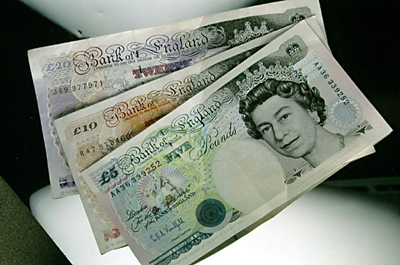
 LONDON: Sterling edged away from a 9-1/2 month low against the euro on Tuesday before inflation data that could dim the prospects of more monetary easing, and as investors took profit on the euro's recent gains.
British inflation is expected to remain elevated at 2.7 percent in December. Analysts said this may give the pound a small boost as prospects dim that the Bank of England will opt for more quantitative easing.
Any gains are likely to be short-lived, however, given that high inflation could worsen an already weak economy by reducing British consumers' spending power.
The euro was down 0.1 percent at 83.11 pence, although it stayed not far from Monday's peak of 83.26 pence, its strongest level since early April 2012.
"High inflation should be positive for the pound because it reduces the chances of more QE, but at the same time it makes it difficult for the UK economy to stabilise," said Nawaz Ali, currency analyst at Western Union.
"Perhaps sterling will get a knee-jerk positive reaction, but high inflation is not what long-term investors will be looking for."
He said he expected positive comments from European Central Bank President Mario Draghi last week to continue to lift the euro towards 84 and possibly 85 pence.
But traders said it faced resistance at 83.33 pence, equivalent to 1.2000 euros per pound. Above there, the 100-week moving average stands at 83.84 pence.
A better-than-expected UK house price survey on Tuesday was offset by news that UK music and DVD retailer HMV has gone into administration, putting around 4,000 jobs at risk.
Some analysts said speculation whether the government will call a referendum on Britain remaining in the European Union was also unnerving sterling investors.
Analysts at Citi said euro/sterling could be vulnerable to a pullback if inflation remains high, but that they would use this as an opportunity to establish fresh long euro/sterling positions.
"We expect that a potential strong inflation print will have only a temporary positive impact on sterling ... more QE could come before long, especially if the UK economy remains weak," Citi said in a note to clients.
Against the dollar, sterling was flat at $1.6080, above this month's low of $1.5992 but stuck below Friday's peak of $1.6182. It held just above the 100-day moving average at $1.6070 and the 55-day moving average at $1.6067.
Sterling's trade-weighted index was at 82.6, just above a seven-month low of 82.5 reached on Monday.
The pound has struggled since Friday when figures from the National Institute of Economic and Social Research suggested the economy shrank 0.3 percent in the fourth quarter of 2012.
Data released on the same day showed UK industrial and manufacturing output fell more than forecast in November, increasing the likelihood the economy contracted in the final quarter of last year.




















Comments
Comments are closed for this article.