



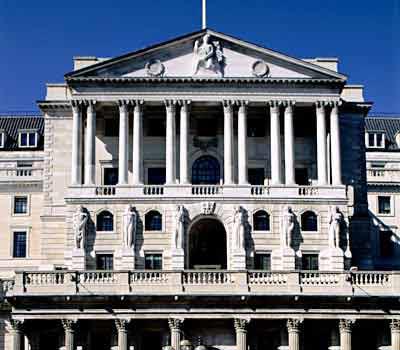
 LONDON: The Bank of England is widely expected to hold its key interest rate at 0.50 percent at a meeting on Thursday, three years after deciding to slash borrowing costs to the current record-low level.
With Britain facing a possible return to recession, analysts expect the BoE to again sit tight over the level of its main lending rate, which over the past three years has favoured people with home loans but disadvantaged savers.
"With the housing market and wider economy already looking weak, there is actually very little scope for raising interest rates as it would almost certainly trigger a double-dip recession," said Phil McHugh, an analyst at trading group Currencies Direct.
The BoE's key rate has stood at 0.50 percent since March 2009 when the central bank also began to inject the British economy with £200 billion under a radical policy known as quantitative easing (QE).
The amount has since been raised to £325 billion following two further interventions the most recent of which was last month with an increase of £50 billion.
Under QE, the central bank creates new cash that is used to purchase assets such as government and corporate bonds in the hope of giving a boost to lending and economic activity.
Whether or not the Bank of England announces further QE in the coming months depends on a series of factors, according to economists.
"With concerns over a euro-area-based downturn having abated for now, the key questions concern whether the domestic recovery is gaining genuine momentum; whether UK inflation will prove relatively 'sticky'; and the role played by oil prices," said economist Philip Shaw at Investec financial group.
The BoE's main task is to use monetary policy tools to try and keep Britain's annual inflation rate close to a government-set target of 2.0 percent. This has proved tricky in recent times owing to high oil prices, although consumer prices are now rising at a slower pace across the country.
The latest data showed that Britain's 12-month inflation rate fell sharply in January to 3.6 percent from 4.2 percent, as the previous year's sales tax hike fell out of the year-on-year comparison.
Britain's economy meanwhile shrank 0.2 percent in the fourth quarter of last year compared with the third, according to recent official data.
A further contraction in the first quarter of 2012 would place Britain back in recession, defined as two successive negative quarters.
Britain's economy is faltering amid harsh state austerity measures, falling consumer spending, elevated oil prices and the ongoing fallout from the long-running sovereign debt crisis in key trading partner the eurozone.



















Comments
Comments are closed for this article.