



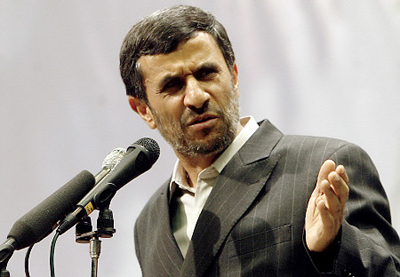
 HAVANA: Iran's President Mahmoud Ahmadinejad was due in Cuba Wednesday amid rising tensions with the West over his country's nuclear program, exacerbated by the killing of a Iranian nuclear scientist which Tehran blamed on Israel and the United States.
He was due to arrive from Nicaragua on the third leg of his Latin American tour, with Cuban media reporting that he would meet President Raul Castro later in the day during his brief visit.
In Tehran, Mostafa Ahmadi Roshan, a 32-year-old nuclear scientist, was killed in a car bombing and the Islamic Republic pointed finger at Israel and the United States, which have vowed to prevent Iran from building a nuclear weapon.
Iran's Vice President Mohammad Reza Rahimi told state television the killing, which occurred in front of a university campus in east Tehran, would not stop Iran making "progress" in its nuclear activities.
Iranian officials noted that the assassination method -- two men on a motorbike attaching a magnetic bomb to the target's vehicle -- was similar to that used in the killings of three other of its scientists over the past two years.
The killing following Monday's confirmation by the UN nuclear watchdog IAEA that Iran had begun enriching uranium in a new, underground bunker, a development which the United States, Britain, France and Germany slammed as an unacceptable violation of UN Security Council resolutions.
Faced with growing pressure from the West over his country's nuclear ambitions, Ahmadinejad on Monday began a regional tour to seek support from four Latin American countries hostile to Washington.
He was to fly in from Nicaragua where he secured the backing Daniel Ortega, who insisted that "countries have the right to develop nuclear energy," after visiting Venezuela where President Hugo Chavez also offered support.
The Iranian leader was to wrap up his tour in Ecuador.
Iranian media have suggested that during his 24-hour visit, Ahmadinejad could meet ailing Fidel Castro, the 85-year-old former president and revolutionary icon, but there was no confirmation from the Cuban side.
Cuba, located a mere 150 kilometers (90 miles) from the United States, defends Iran's right to develop nuclear energy for civilian purposes.
Tehran insists that its nuclear program has no military purposes, rejecting Western charges that its uranium enrichment program masks a bid to covertly build a nuclear bomb.
Israel, Tehran's sworn enemy. has threatened to launch air strikes on Iran's nuclear facilities. The United States has said "all options are on the table" in terms of dealing with Iran -- including military action.
Tehran has meanwhile threatened to close the strategic Strait of Hormuz at the entrance to the Gulf if it is attacked. Twenty percent of the world's oil flows through that strait.
The slain Iranian scientist was a deputy director at Iran's Natanz uranium enrichment facility, according to the website of the university he graduated from a decade ago, Sharif University.
The Iranian vice president, in charge while Ahmadinejad is on his Latin America tour, said: "They (Israel and the United States) should know that Iranian scientists are more determined than ever in striding towards Iran's progress."
There was no immediate official Israeli or US reaction to the accusations.
























Comments
Comments are closed for this article.